
Metamorphosis as Practical Framework for Creating a Sustainable World
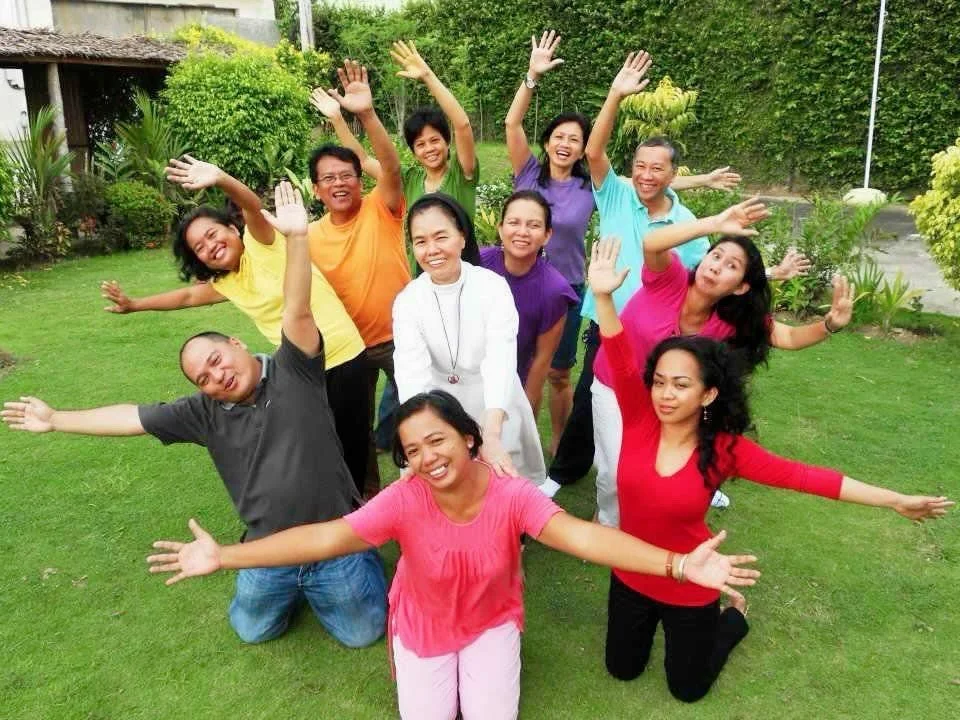
Photo: Members of MISSION Cebu node posing to form a butterfly. MISSION had 8 to 10 nodes (a unit representing a city or a town) across the Philippines at the time this photo was taken in 2011.
By Weng Suarez
The metamorphosis of a caterpillar into a butterfly is one of the most commonly used examples when talking about the process of transformation. It is aspirational, ambitious and lends hope and meaning in the struggle, or trial, or challenge, or however you name it. At the same time, the promise of this kind of transformation story, the way it’s commonly told, can seem like oversimplification, or feel naive, or sound like platitudes about how something ugly can turn out to be beautiful in the end even when one may not see it or think it happening.
The story goes that the caterpillar enters its pupa stage and creates its cocoon, a protective covering as it liquifies and starts eating itself—a painful and necessary suffering—until one day, its suffering ends and the beautiful butterfly emerges.
But what really happens in the cocoon, what “eats itself” and what “the butterfly emerges” mean at the cellular level offers us a guide of how individuals, no matter how few, who have a dream, a vision, a desire, can co-create the future they want—perhaps, create business leaders who can both drive results and humanize the workplace, or a community that advances economic progress and preserves the environment, or a world that harnesses AI power and upholds what is truly human, et cetera. These are really huge lofty goals, it can be overwhelming and may be unthinkable given the state of affairs in the world right now, but again, the process of metamorphosis shows us exactly how a new kind of society can be created. And if you look closer, you will see how the “islands of coherence” that we have been talking about in our IZL circles these past months start forming. We have a glimpse of hope and an image of a possible future that is grounded in how nature works and is supported by a field of intelligence that gives it form.
The Emergence of New Cells
When the caterpillar is inside the cocoon and it has liquified itself, new cells start to emerge. They are called imaginal cells. The imaginal cell is foreign to the caterpillar’s immune system and so it starts to fight it, kill it, get rid of it. Most of these imaginal cells die. Some live—just a few of them. But those that live start banding together, forming clusters of imaginal cells. They become stronger, and more imaginal cells start emerging. They band together. In elementary biology class, we learned this as the formation of tissues. As more and more of these cells emerge, and more and more cluster together, the tissues form organs, and then organs create organ systems. These imaginal cells carry the image of the future it was designed to be—the new imaginal organism.
The Movement of Imaginals
I met a group of “imaginals” in 2011. You can liken them to Paul Ray and Sherry Ruth Anderson’s cultural creatives. I was 28 back when I met them, and I came to realize that those who said I was too idealistic—that the kind of world I imagine is not possible—were wrong. There I was, holding the question of whether I had real capacity to help change things I didn’t like about our country or if I only had opinions and wouldn’t actually work for what I think needs to be done. They showed me a glimpse of a different world in a highly localized context that is largely global, and universal, in its framing. They worked in alternative education, organic and biodynamic farming, environmental protection, new politics, holistic healing, spiritual science, social entrepreneurship and other alternatives that were geared towards creating a more sustainable world.
They are very much like imaginal cells that have banded together. In fact, they were called MISSION, or the Movement of Imaginals for Sustainable Societies through Initiatives, Organizing and Networking. Members of MISSION either birthed or co-carried an initiative as a way to create a container for his ideas and aspirations, to ground them and make them a reality in the world. The individuals and collectives in MISSION which is present in 8 to 10 cities or towns in the Philippines is a strong cultural force that has started to shape and influence people and projects in government and in business over the past 12 to 15 years.
The Initiatives: The Imaginal Tissues
If you have heard of that quote from Buckminster Fuller about creating change in society, you are familiar with the framework. He said, “You never change things by fighting the existing reality. To change something, build a new model that makes the existing model obsolete.”
The imaginal cells that seem to have come from out of nowhere didn’t fight or attack the old cells, they banded together, with every single cell carrying an image of the future, and did exactly what they knew they had to do—create the imaginal organism that is the butterfly. Imagine the resonant frequency between them and among all other imaginal cells for them to have been able to do that. The more clusters they formed, the stronger the message is broadcasted until there is only one resonant frequency in which they move with. How deeply poetic can something scientific be?
In Cebu, a province in the Philippines, we found ourselves confronted with the issue of Golden Rice, a genetically-engineered rice, in 2014. People from different walks of life coming together, moved to action by its threats to the environment, biodiversity, human health and quality of life. In the Philippines, it is common for farmers to get buried in debt as they keep borrowing money for farming inputs—seeds, fertilizers, pesticides—and they stay poor so that most of the next generations don’t ever want to farm anymore.
Shortly after we awakened to the dangers of the commercial propagation of Golden Rice and its threat to overturn a previous Supreme Court decision banning GMO eggplant, we formed the GMO-Free Cebu movement. We gathered more than 500 farmers and farmer associations, along with non-farmers, in an anti-GMO conference where we heard a resounding voice of dissent that had come from their own experience of being in a vicious cycle of growing GMO corn.
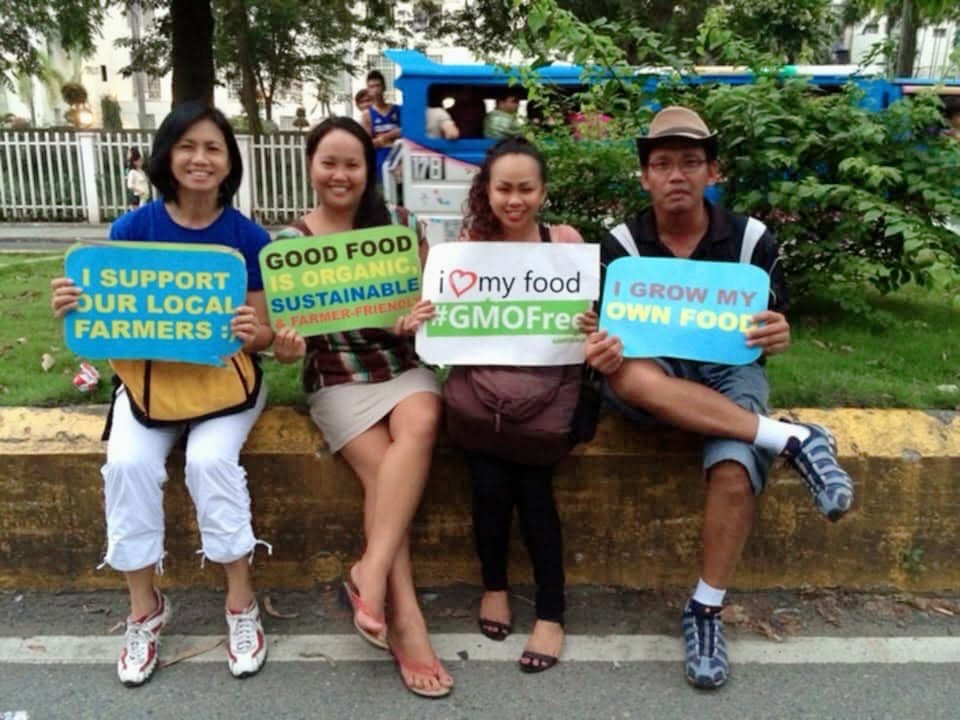
Photo: Some of the members of MISSION Cebu node who are co-founders of the GMO-Free Cebu Movement and the Cebu Farmers Market
We asked ourselves. If we don’t want GMOs, what alternative are we then offering the people of Cebu? An idea was born—the Cebu Food & Fun Festival where several farmers who have been practicing natural and organic farming showed up with their vibrant and colorful harvests. Consumers and advocacy supporters who have been looking for access to cleaner, healthier and more nutritious food loved it and asked the next question: where do we go for weekly access?
Organizing: The Imaginal Organs
To answer the question, the Cebu Farmers Market was born. A business owner, who was also a cultural and environmental advocate, offered a place to hold a weekly market for free. An all-volunteer team organized the farmers, invited musicians and artists to perform, spread the word and attracted consumers. The market became a central hub for people coming together, celebrating the beautiful and bountiful harvests of our farmers. Doctors came. Nutritionists came. Chefs came. The market was so alive.
In no time, students started coming to study how CFM has been able to build community and how it was starting to influence buying decisions, help the farmers, and at the same time raise awareness for the advocacy. We continued to participate in efforts to influence policy and legislation but we didn’t rely on it. We continued to nurture and grow relationships at the market. It is a cultural hub from which many ideas and partnerships have been born. An alternative that is so attractive has started to make the old system obsolete to a segment of the food culture.
To this day, CFM is the only physical market in Cebu that sells only organically-grown or naturally-grown produce, fruits & vegetables as well as naturally-processed food products. It has two main pop-up markets and gets invited to major food fairs in the province. After recently getting funding support, a daily store is currently being prototyped. CFM turns 11 years old this month. This year marked its first year as a formal Agricultural Cooperative.
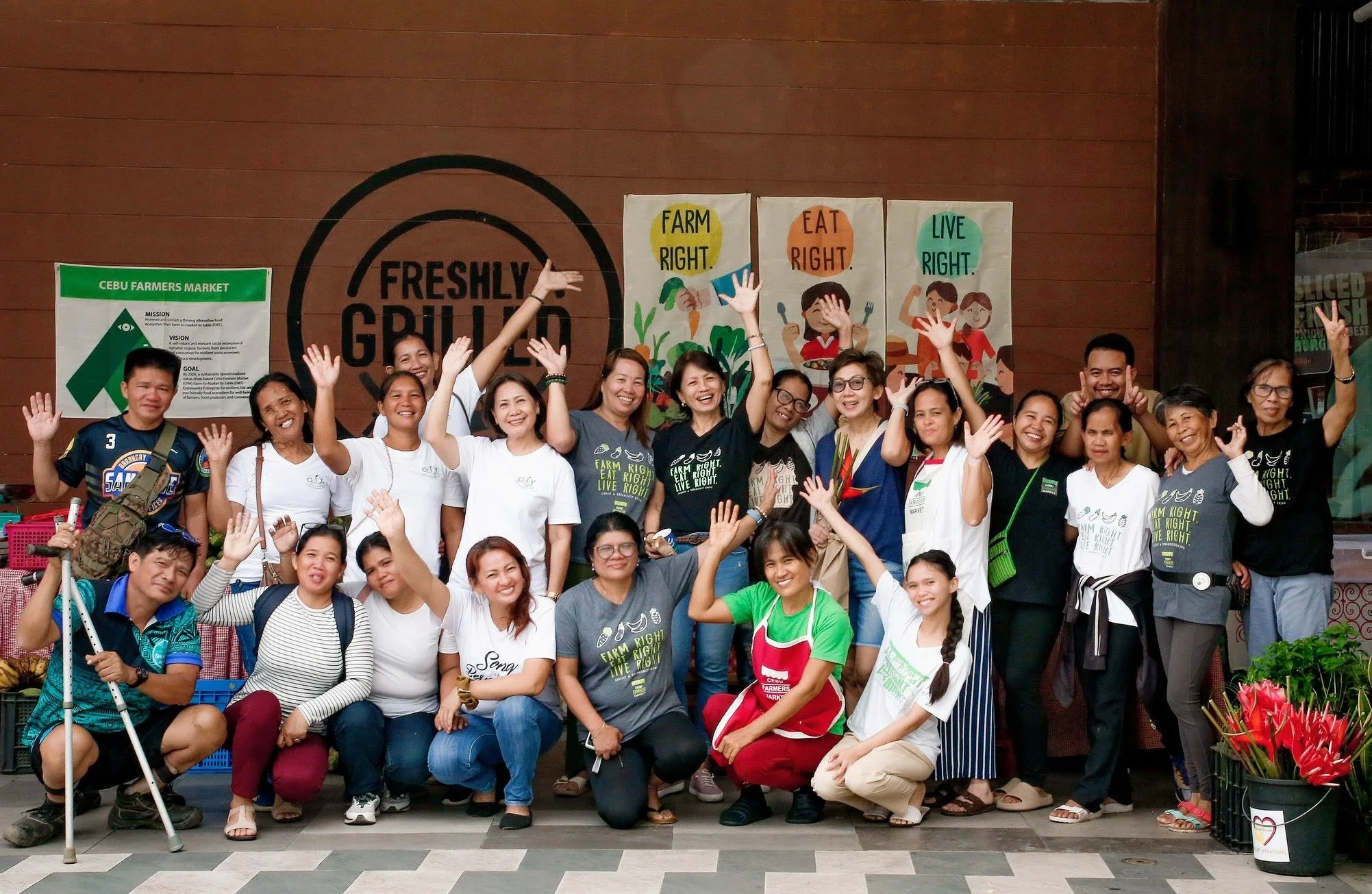
Photo: Some of the Farmers, Vendors and Members of the Cebu Farmers Market Agricultural Cooperative
Networking: The Imaginal Organ Systems
As the market started growing in the first 2-3 years—restaurants asking CFM to supply produce, subdivision owners offering to build a market for its homeowners, mall owners inviting us to hold a weekly market—we were shown that the work is beyond running the pop-up markets. Sometimes, some farmers couldn’t sell because their vehicle, or somebody’s vehicle who they ride with, broke down. At different times of the year, the changing climate conditions affect the growing and harvesting. Farm and farmer development, getting more access to organic seeds, organic certification and funding support for wider conversion to organic practice et cetera were some of the questions we were holding.
These demands led us to seeing the systemic challenge of lack of access to organic produce in the market. The job is clearly not just to connect consumers directly with farmers, though that alone is a huge task, but to look at the entire ecosystem and see how different players need to come together to build on each other’s efforts. To respond to the call, CAFEi, or the Communities for Alternative Food Ecosystems Initiative, was born. CAFEi attends to the other ecosystemic challenges beyond running the market operations. It has also touched several communities, helping them become more self-sufficient in terms of getting access to healthy and nutritious food—we called it the Grow-it-Yourself Project or GIY.
Over the course of the years, different partners emerged, like the Global Seeds Savers who trains and supports our farmers to learn how to save seeds, the Slow Food Movement (Slow Food Sugbo) who made our farmers see how valued their heritage crops are and the Participatory Guarantee System (PGS Sugbo) which makes organic certification accessible at significantly lower costs. Funding still does not come easily, but we are fortunate to have met some who share the vision of CAFEi and have funded what seemed to be “un-fundable” from the old, caterpillar-cell, lens of unimaginative thinking.
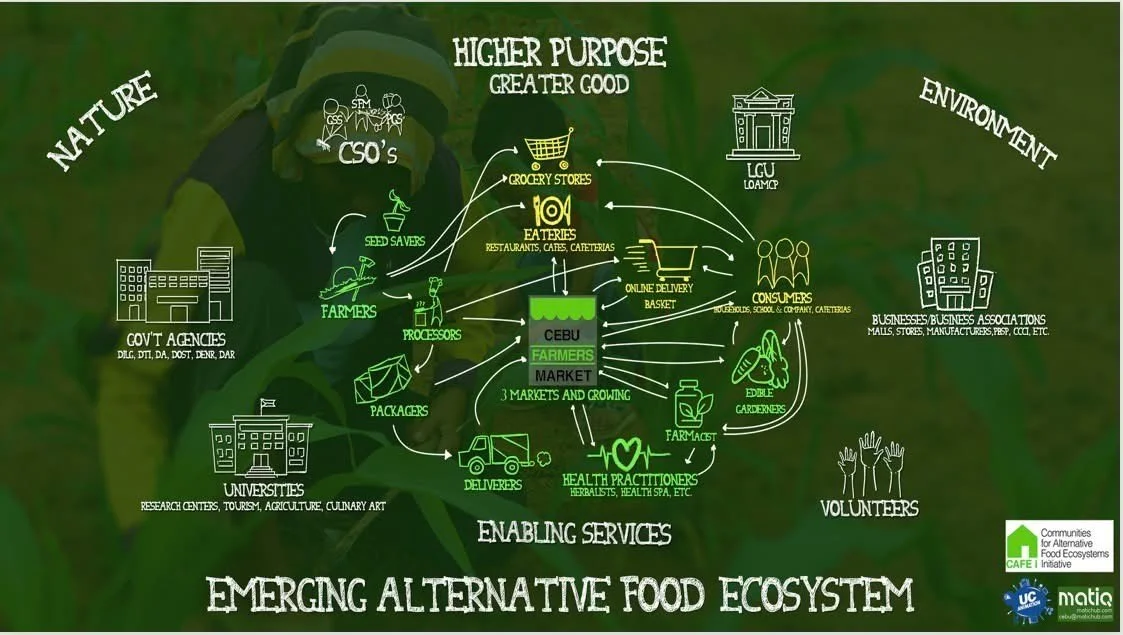
Photo: CAFEi’s map of the emerging alternative food ecosystem
Our Islands of Coherence
Building resonant communities does not happen by following another’s playbook. But some frameworks can guide us. It requires deep listening—to what wants to happen—and staying true to its essence. Serving a larger purpose allows us to become more resonant so that we find others who can be our co-journeyers and co-creators. As leaders, we must connect with that larger purpose so that we can truly lead—not from the place of ego but from what Ginny Whitelaw Roshi calls our selfless Self. Our work at the Institute for Zen Leadership helps leaders see beyond the illusions and the agenda of the ego that can get ahead of what wants to emerge.
The birthing process of and nurturing initiatives like the Cebu Farmers Market and the Communities for Alternative Food Ecosystems Initiative is a deep transformative journey for the individuals working for it—one that requires constant inner work that shapes its outer results.
May we all be radiant and resonant to lead our network of communities, our islands of coherence, in banding together to create our imaginal organism: the world we long to be
P.S. I dedicate this writing to my dear mentor,Nicanor Perlas, who passed on last August (2025), who gifted me and many others with the frameworks of MISSION and The Journey of Becoming Fully-Human, and continues to be a beacon of light for us. Nick reminded us that when the challenge gets bigger, our capacity grows larger. There is Providence, so we only have to say “Yes!”
Weng Suarez is the Operations Director of the Institute for Zen Leadership. She co-founded the GMO-Free Cebu Movement and the Cebu Farmers Market and is currently the Board Chair of the Communities for Alternative Food Ecosystems Initiative.
Weng is a Certified HeartMath Trainer for flagship workshops, The Resilience Advantage™ and Activating the Heart of Teams™. She is also both a Certified Zen Leadership Instructor and FEBI Coach.