
Physics, Philosophy & Practice—A Leader’s Guide to Flourishing Futures

“The free flourishing of each is a condition of the free flourishing of all.” This simple principle from Roy Bhaskar can guide leaders to discern and reinvent social patterns that lead to flourishing. Credit: PeopleImages, Getty
By Ginny Whitelaw
Originally published on Forbes.com on September 1, 2026.
Imagine you’re going on a car trip. You open a map app, plug in your destination and current location and it spits back a route or perhaps a few possibilities. You could take the fastest route and get there in 3 hours and 15 minutes, or maybe an alternate route that takes 4 hours, or make up your own route that will take longer. This simple interaction highlights the interplay of individual freedom of choice with social patterns—in this case, roads—that shape and limit those choices. In leadership, and truly all aspects of human activity, our present-moment choices or agency is guided by patterns inherited from the past—not just roads, but policies, processes, social divisions and hierarchies, cultural norms and values, language and more. Our choices either reinforce those patterns (as in the process of a footpath becoming a road, becoming a highway) or, in acts of transformative leadership, reinvent them.
The challenge facing leaders today is that the social “roads” we’ve inherited and perpetuated are breaking down and are not taking us to a place we want to go. They are based in what Charles Eisenstein calls a “Story of Separation”, grounded in a concept of self as a separate individual, separate from others, separate from nature, who uses people and consumes resources to maximize its power, control and chances of survival. While there are certainly selves who are like this—it pretty well describes the administration currently running the United States—it is such a partial and defective view of human capacity that the patterns based on it lead to their own destruction, as in the collapse of ecosystems, trust, and social order that we’re currently witnessing.
An opposite story is emerging – a “Story of Interbeing,” grounded in a more truthful, complete view of the relational self, intertwined with others and nature in a resonant dance with life, endowed with creativity and gifts that can bring value to the world and meaning to one’s subjective experience of living. The greater merit and applicability of this new story can be ascertained from physics to philosophy to spiritual practice. Physics shows the rational mind how we could mistake the self as separate and the fuller truth of our interbeing. Philosophy, in the form of Roy Bhaskar’s critical realism*, gives us a practical criterion based on flourishing to discern better from worse social patterns and create new “roads” aligned with the new story. Spiritual practice makes interbeing our genuine subjective experience—not a belief or a story we’ve heard—that we can progressively embody and enact, which is what we mean by Zen Leadership. Taken together, these three pillars can give today’s leaders confidence in the new story, competence in discerning better ways to create flourishing, and embodied capacity to lead people, organizations and communities toward it.
It’s no accident that we grew up with the Story of Separation. Our subjective experience feels like ours alone and physically we appear separate from others. Science likewise grew up assuming separation and objectivity; i.e., a self apart from what it was studying. Moreover, it assumed we could study things by breaking them down into parts, down to the basic building blocks of nature, which the Greeks called “indivisible” i.e., atoms. These assumptions were adequate to give us a good deal of knowledge from Newtonian mechanics to an understanding of electricity and magnetism—enough to fuel industrial revolutions, the Modern Age, and the seeming superiority and separateness of rational intellect.
But science didn’t stop there. In the 20th century, it went on to discover the limitations of its own assumptions. The building blocks of nature were not blocks, after all, but rather resonances (i.e., co-vibrations) within a 10-dimensional field of potentiality. The process of perception—another form of resonance—was not passive, but rather an activity that collapsed waves of probability into particles we can perceive in our limited three dimensions. Moreover, resonance emerged as the way energy changes form and, through its specificity, all forms emerge. It is an inherently relational process. Since breaking things down to study them changes relationships, it can miss much of the potentiality of the object under study. Thus, separation, objectivity and reductionism were all revealed as simplifying assumptions that were useful under limited conditions but not ultimately true. Modern physics revealed the more complete truth of an interconnected universe of empty potentiality resonating into energetic and material forms in which we are manifestations, limited perceivers and co-creators.
Philosophy also continued to grow. Compiling numerous theories of individual and social development, Integral Theorist, Ken Wilber, showed how rationality is but a stage in human development and consciousness. While its mainstream emergence enabled the growth of science and technology, as well as democracies and free markets, humans had to grow up through earlier stages to get there, and it is by no means a stopping point. Further stages of personal growth embrace the rational and add to it greater capacities for emotional intelligence, gaining the benefit of diversity, managing paradox, thinking in systems, playing in the flex and flow of life, and ultimately non-dual consciousness.
Non-dual consciousness likewise infuses the philosophy of Roy Bhaskar in his view of the human being as an inseparable, interwoven manifestation of the universe, endowed with unique gifts, the free and full expression of which leads to a flourishing life. In what Bhaskar calls our “ground state,” humans have the capacities for love, freedom, creativity, and awakening. These traits can be obscured, but not destroyed, by alienation—i.e., when we are forced into subjugation or “forget” our interconnectedness and act purely from ego self-interest. Social patterns are not simply neutral or matters of opinion because they have real effects on human action and suffering and some are better than others at reducing alienation. Bhaskar’s guiding principle for discerning better from worse social “roads” is universal human flourishing whereby “the free flourishing of each is a condition of the free flourishing of all.”
In a practical sense, this doesn’t mean that every person must flourish before anyone can flourish. But it does mean that durable human flourishing cannot be built on others’ systematic lack of freedom, deprivation, degradation, or exclusion. “Others,” in this case, extends not only to human beings, but to all beings and nature, recognizing our material interdependence with the whole picture. Social patterns that enforce the domination of some over others are more alienating, defective and unstable, not flourishing in its fulfilled form.
One doesn’t have to look far for evidence supporting Bhaskar’s claims. Practices based on domination over nature have led to climate instabilities and ecosystem collapse. Economic policies that reproduce and amplify wealth disparities have led to fear, greed and social instabilities. A U.S. administration that pits one group against another, sows anger and falsehoods, enacts violence and warfare, and self-deals to levels of corruption it doesn’t even bother to hide, has fed global instability, widespread distrust and alienation.
Bhaskar’s flourishing criterion gives leaders a way to discern better from worse policies, processes and structures that is not just opinion but based on a bigger truth. As leaders attempt to create value amidst today’s crises and chaos, it can help them avoid old social patterns based on a Story of Separation and create new roads that are better aligned with the more complete Story of Interbeing. Here are some examples of how this might play out in evaluating social patterns, which could apply at any scale, e.g., from roles on a team to tax policies.
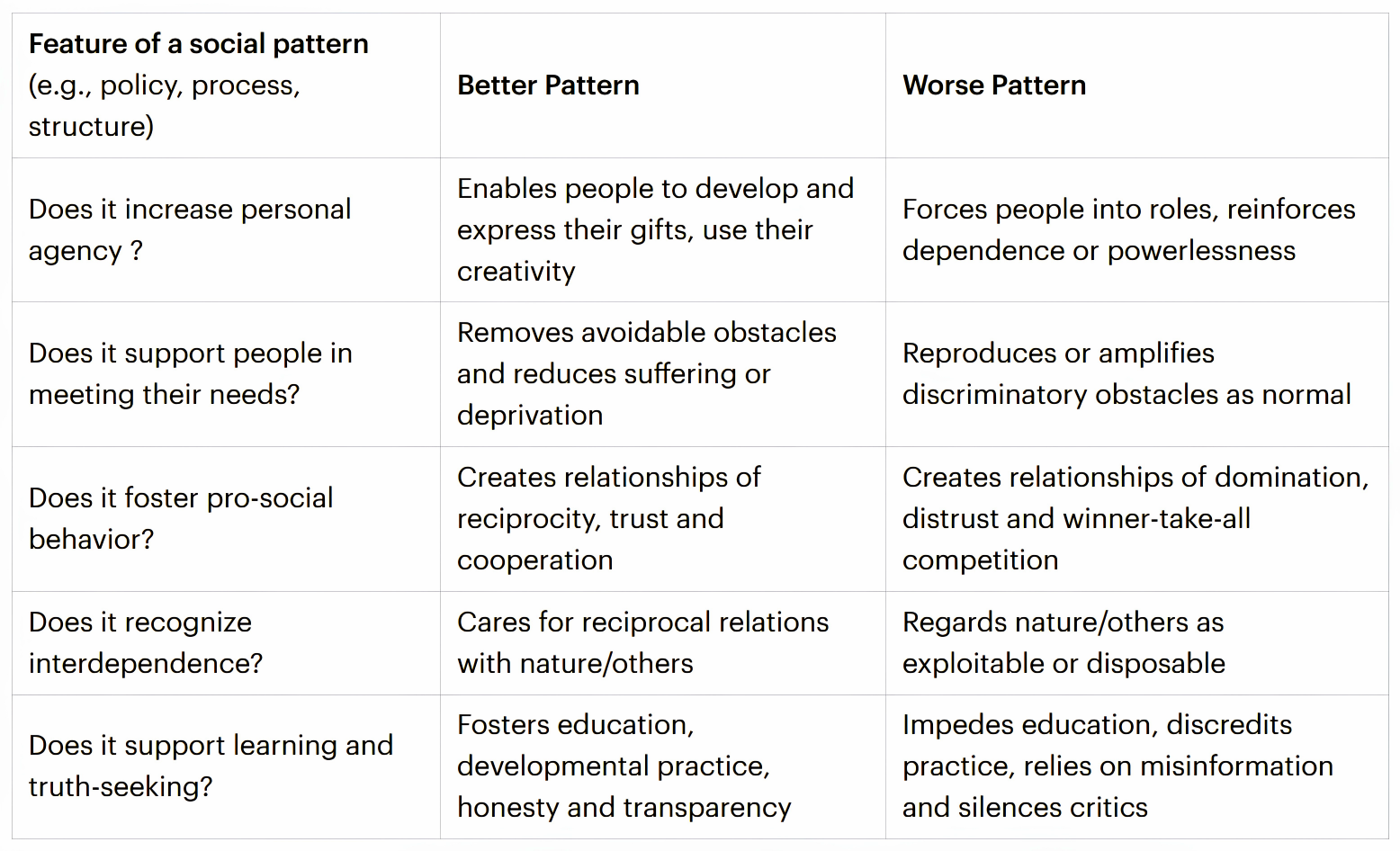
So, to trace a few examples, a team that keeps their roles loose and agile, aligned by purpose, where each contributes what they know how to do best or next, would flourish better than one having rigid roles and power relationships where tasks fall into the cracks of “not my job.” A business model that cares for the environmental costs and social impact of its products along with profits would be better than one that cares only about profits. A community healthcare system that integrates physicians and patients with farmers growing healthy food, nutritionists, and community support (a real example of which already exists) would be better for flourishing than a system of siloed separation where patients without access to healthy food see doctors in 15-minute segments scripted by insurance reimbursement policies. A tax code that draws proportionately from the wealth of society and covers present day costs would promote more flourishing than one that taxes the wealthiest the least and saddles future generations with unrepayable debt.
Having a principle to discern better from worse social patterns that is not just a matter of opinion, left or right, but based in a more complete physics of the universe is no small thing. It could be coded, for example into AI (whose developers are rediscovering philosophy), to discern, even in the most complex scenarios and intersecting crises, what are better ways to address them. AI coded in such a way could augment human intelligence in crafting the new social roads in business, government, education and healthcare that more accurately accord reality and lead to greater flourishing and less alienation. As people are less alienated, they are better able to actualize their potential for love, freedom, creativity and awakening. Or, as Bhaskar might say, as the clouds of social and personal impediments are removed, the divine sun of each person shines more brightly.
Which brings us to the third pillar, that of developmental or spiritual practices that support the journey to flourishing. As people engage in truth-seeking and practices that cultivate their capacity for love, freedom, creativity and awakening, their consciousness expands beyond the separate self to the relational self, to glimpsing, grasping and growing in non-dual consciousness. When subjective experience, which feels like it is ours alone and originally wrote the Story of Separation, expands to reveal that we are also the whole picture—a realization at the heart of Zen and mystical experience across ages and traditions—it is so shocking, illuminating and challenging that it changes the patterns of our life and, in many cases, the social patterns we reinforce or reinvent.
So, imagine you’re going on a car trip. The flourishing destination you want is not yet on the map and the roads to it are not yet built. Some existing roads can take you part of the way, others are dead ends, and new patterns are needed. That is the situation facing leaders today. But far from being lost, we are also the whole map, the whole picture, with creative agency to affect parts of it. Supported by developmental and spiritual practices that provide insight from a state of interbeing and a universal principle aligned with the Story of Interbeing, we have what we need to discern better from worse social roads and reinvent new news ones that lead to the free flourishing of each and all.
*With thanks to Leigh Price, Sean Esbjörn-Hargens and the Institute of Applied Metatheory for elevating the work of Roy Bhaskar and its relevance to our times.
Ginny Whitelaw is the Founder and CEO of the Institute for Zen Leadership.