
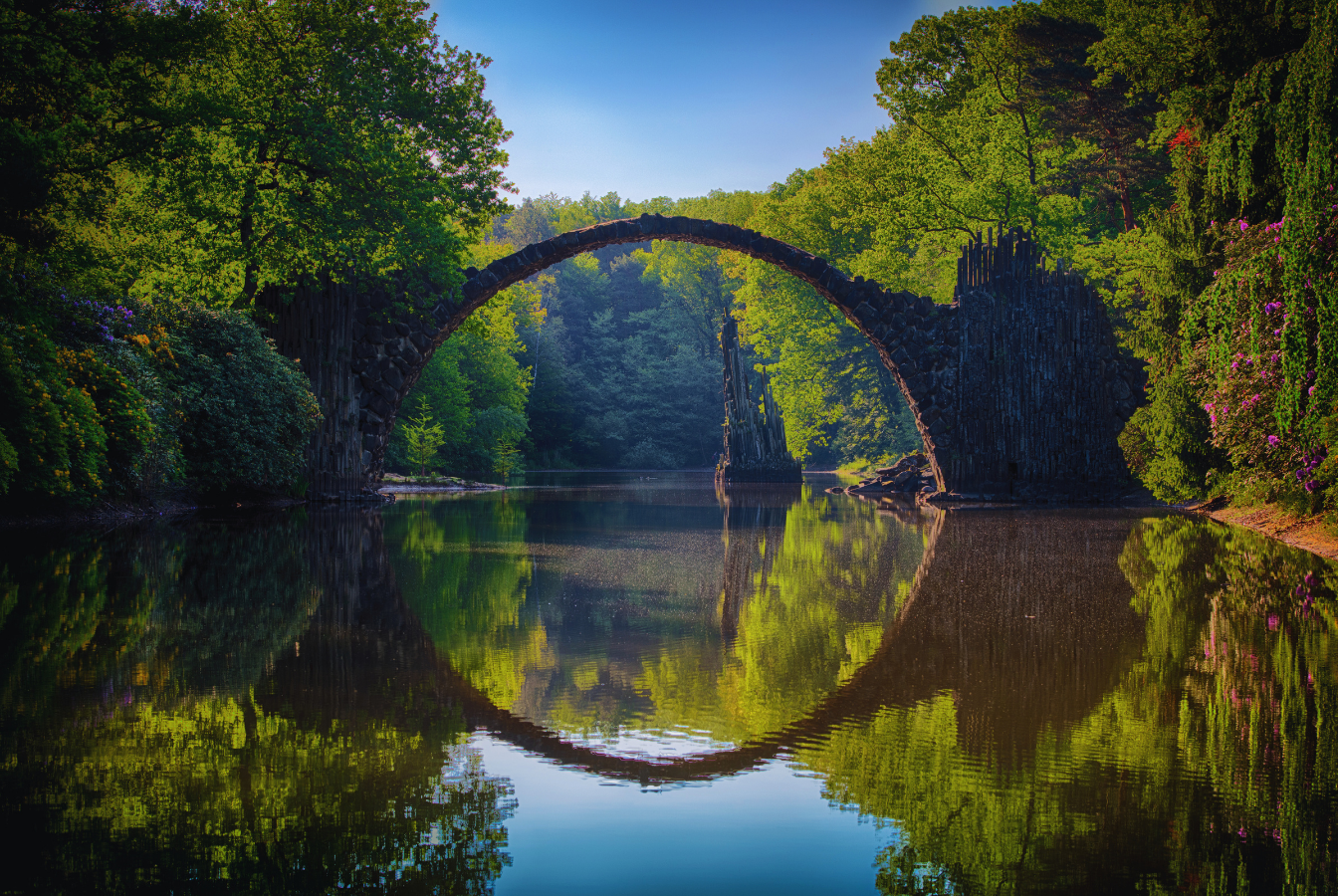
We need leaders who can build bridges between disciplines and social divides to address the interwoven crises of our times. But a special kind of bridge is called for, namely one that rolls like a ball with larger patterns and the flow of life. Credit: Martin Damboldt
By Ginny Whitelaw
Originally published on Forbes.com on July 1, 2026.
Zen is to transcend life and death, all dualis
To truly realize that the entire universe is the True Human Body…
Yagyu Sekihusai named it Marobashi no michi, a bridge like a round ball—being in accord with the myriad changes of life. - Omori Sogen Roshi
Dr. Kristi Crymes is a bridge builder. She’s a family medicine physician who saw so many of her patients falling through the cracks of the healthcare system despite her best efforts to support them. They couldn’t get insurance coverage or afford their medications, or they had little access to healthy foods, nutritional information, a healthy lifestyle or even fresh air. She knew, as so many healthcare professionals know, that a 15-minute visit in her office was not enough for the healing that was needed. Working with farmers for fresh produce, the head of community gardens for food distribution, nutritionists, social workers and fellow physicians, she helped pilot a program, HealthScripts, that brought patients together into health circles, launching a new and successful model for community health.
That was just the beginning. Word of the pilot spread quickly, and other communities and healthcare practitioners started asking how they might implement a similar program. Crymes set about to clarify what physicians would need to replicate and locally adapt projects like HealthScripts. They would need, for example, an understanding of food as medicine, nature as medicine and lifestyle medicine, along with a roadmap for where bridges in the community would need to be built. And they would need the wisdom, resilience and skills Kristi found from her own training and teaching in the Institute for Zen Leadership’s Healthy Embodied Agile Leadership (HEAL) program. She began weaving these elements together into a year-long fellowship for clinicians and their community partners so they could implement such an integrated model of healthcare. Together with other HEAL graduates and inspired colleagues, she formed the Open Field Health Collaborative* (OFHC) to enable this work to spread. In writing its founding narrative, Crymes speaks to the value of both working within the fraught systems of today and sensing beyond them to more flourishing possibilities for the future. Her work is a model of building bridges, both within communities and between the past and the future. It also models key leadership strategies needed for bridge building: embracing both sides, listening beneath the surface and being resourced from abundance.
The Need for Bridge Building
Healthcare is a salient example the bridge building needed across social, political and industrial sectors, sitting as it does on the frontlines of what the World Economic Forum calls a planetary polycrisis. Healthcare registers the effects of climate catastrophes, ecosystem failures and food shortages that also fuel political and social crises. Healthcare feels the squeeze of higher prices, lower funding, and greater demand, exacerbated by greed and corruption. It reflects the health issues of young people who don’t know where they fit in a climate-disrupted, AI-world. Wellbeing suffers among the majority of the world’s population that lacks access to even basic healthcare and even in the world’s richest healthcare system—the United States—two thirds of the people worry about access or affordability.
The term “polycrisis” points to the fact that, while each crisis is significant in itself—climate, biodiversity, health, AI, social, political—their causal entanglement and mutual amplification are exponentially problematic. That’s also why a new kind of leadership that can build bridges across what have been separate disciplines, separate sectors, and partisan divides is essential to our collective healing. Conventional leadership is based in separation, starting from a view of an ego-I that feels separate and prioritizes self-interest, leading to separation between people, professions, and politics and is simply not up to the challenge of interconnected crises. Conventional “bottom line” leadership will only make matters worse.
By contrast, bridge-building leadership works by healing divides. As in the HealthScripts program, it starts locally and grows at the speed of trust and relationships. Scaling doesn’t happen through automated, AI processes or social media hype. It happens when one, then another, then a small group of inspired leaders feel called to create a more flourishing future for their community. It doesn’t start with global policy or abstract concepts but on the ground with real world actions like convening community circles, removing fences, or restoring a greenway. Here are three critical strategies to guide the work.
Embrace Both Sides
Bridge building entails having a foot in each of two worlds, and a wholesome appreciation of both. Barry Johnson blazed the trail for this work in managing what he called polarities, or paradoxical forces, both of which have some truth or value, but if overdone to the exclusion of the other, lead to concerns, even crises. Optimizing the two forces together—what in Zen Leadership we call the flip from “or” to “and”—leads to a higher-level truth or even greater value. Moreover, one can embrace and embody the greater truth that resolves the dualism of seeming opposites and lead from there.
For example, healthcare practitioners may feel pulled between the forces of practicing within existing systems and practicing true to purpose, which they may not find satisfied in existing systems. If they choose only for the status quo, they will likely burn out. If they choose only for being true to purpose, they may fail within existing systems or exit them altogether. If they embrace the overarching truth that both existing systems and their purpose arise from the same healing impulse or source and lead from there, they can be bridge builders between those systems and the larger community. Moreover, having a foot on both sides—the needs of the system and the needs of the community—bridge builders know where the gaps lie, where relationships need to be built, and how to connect needs with services.
Likewise, healthcare systems may struggle between surviving the present (short term) and finding a better future (long term). If they focus only on the short term, they won’t find better ways of delivering healthcare in the future. Likewise, if they don’t focus enough on the short term, there is no long term. Leaders who can embrace that the two timeframes need each other in the endless unfolding of their healing mission will be bridge builders to the future. Such systems will attract and cultivate bridge-building practitioners and be more open to innovations, such as the work of OFHC.
Listen Beneath The Surface
A core skill of bridge builders is that they listen deeply, beneath the litany of labels and fears to where healing is needed or common interests lie. To listen deeply is to embrace the two sides of self and other, resolved in the unifying truth that we’re listening to an aspect of ourselves. It is to listen with our whole body as an instrument, registering the felt sense of the other’s words and where they land in us. When we listen beneath the surface, others feel heard, trust is built, relationships are nourished.
To listen at depth calls for two skills, both of which can be readily trained and repeatedly practiced. First, we have to be able to quiet the noise within. Like ripples on a pond, the calmer our waters, the more subtle the signals we can register and the less we distort them. Long, slow exhales with feet flat on the floor are good for this, allowing the breath to drain down through our lower abdomen (hara), through our feet, and into the earth. The second skill is to be aware and self-regulating of our own triggers when we hear unsupportive perspectives. Granted, there are some people who are so disturbed, their views cannot be reconciled into a healing solution. But the more generously we can listen to diverse perspectives as necessary pieces of the whole picture, the better informed is our bridge building and the greater its span. A key skill here is learning to work with the fears triggered in us during difficult conversations—getting to know those fears, reframe them, and even see through them, whereby they lose their grip on us.
Be Resourced From Abundance
As Crymes observes in the bridge-building work of OFHC, practitioners have to be able to trust that they can do the work without being destroyed by it, which means they have to feel resourced from abundance, not scarcity. That abundance comes from connection that expands our sense of self. It might be connection with divine source, nature or ground of being, absorption in beauty, one-with purpose, being in flow with a team, belonging in a community or all of the above. The more we conceive of ourselves as connected, the greater our sense of abundance. Conversely, the more separate we feel, the more we run on the scarcity of our own battery power and give room for fear to grow. Zen training blasts open the sense of connectedness to the interpenetrating experience of being one-with all of it: our true Human Body being the entire universe. We go from a local, separate self barely hanging on in the chaos to our whole self with local capacity to heal and build bridges or, as Jill Bolte Taylor put it after an ego-obliterating stroke, “having the power of the universe with manual dexterity.”
But there’s an important aspect to this abundance that informs the kind of bridge builder that we are. Sekihusai tried to capture it as a bridge like a round ball—being in accord with the myriad changes of life. While the geometry of such a bridge may bend the rational mind, it perfectly expresses the kind of bridging we need, which is not static structure so much as vibrant, evolving relationships.
Another master once described Zen as being like a ball on fast-moving waters. If you picture such a ball, you can imagine how easily it moves as the waters pick up speed, move left, move right, or tumble over rocks. But if you now imagine you thrown into those fast-moving waters, very different reactions arise. There’s likely to be grasping, resisting, skillful and futile efforts to swim and worry about what’s up ahead.
And so it is that being resourced from abundance comes as part of a bargain to accept life and flow with its myriad changes. Acceptance does not mean we have to like what’s happening, but only that we see it clearly and work with it as it comes, extending our energy and efforts toward what we care about. The more connected we are, the more abundantly we’re resourced and the more we care for the whole picture. We’re not only building bridges to heal the failing systems and polycrisis of our time, but we are a bridge between the past and the future, taking our stand in the present, and bringing our purpose to life.
As these three leadership strategies come together, they also become mutually amplifying, creating a virtuous cycle. Embracing the “and” of two sides helps us become the other, even when we see things from different perspectives. We’re able to listen more deeply and, rather than resisting, find a unifying truth that we both care about and that aligns our efforts. As we keep resolving divides to a greater unity, we ourselves feel bigger, more alive, and on purpose. Abundantly resourced by life itself and its myriad changes, we find the bridges we’re building are not only to a more flourishing future for our communities but to our own freedom and awakening.
Ginny Whitelaw is the Founder and CEO of the Institute for Zen Leadership. She is also an advisor to OFHC.