
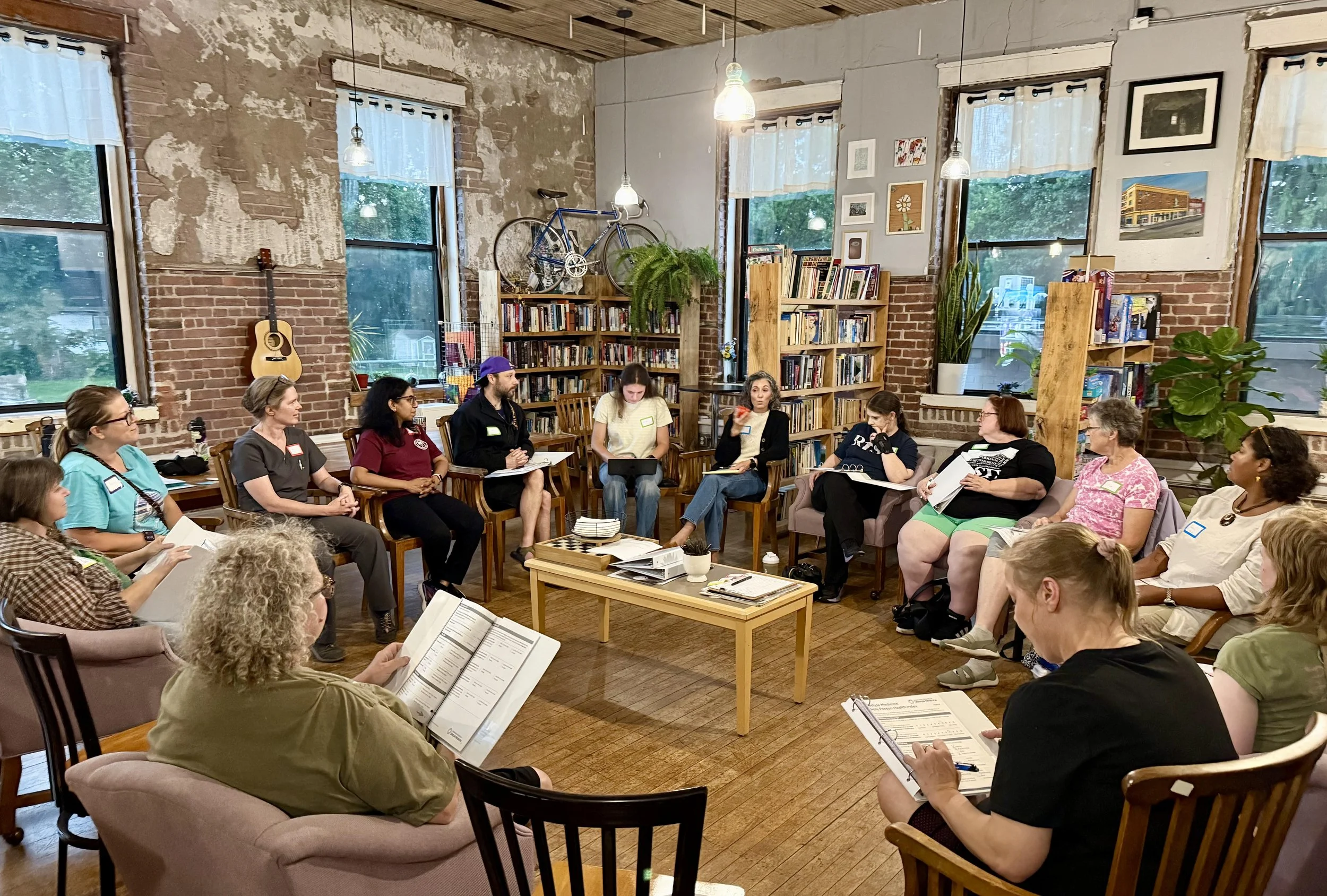
A Health Circle in session — the community health model at the heart of Open Field Health Collaborative’s work. (Fairbanks Community Hub Springfield, MO) Facilitating with the tomato :) is Dr Katie Davenport-Kabonic, Dr Audrey Williams, pre-medical service project student lead at Drury University with her advisor, and a Community Health Worker with Springfield Community Gardens along with our community participants.
Written by: Kristi Crymes
Editor’s note from Ginny: Our IZL Board Chair and HEAL Director, Dr. Kristi Crymes, is also the founder of the Open Field Health Collaborative (OFHC), training practitioners and guiding communities toward integrated, innovative models of medicine and community health. The story of OFHC that follows beautifully speaks to a truth and necessity that is resonating with practitioners, farmers, administrators, community leaders and funders alike (A more complete narrative of the Fellowship is here). At the heart of the formation she speaks to is the HEAL curriculum, which she is skillfully weaving into a year-long fellowship to cultivate a special breed of bridge builders who can help heal patients, communities and ailing systems.
OPEN FIELD HEALTH COLLABORATIVE
The Open Field Fellowship
A Founding Narrative
June 2026
The formation we are calling for in others,
we must first be willing to enter ourselves.
That is what makes this fellowship possible.
I · WHAT WE SEE
The world health requires already exists.
In every community, in every county across Missouri and beyond, the people and the knowledge that genuine health requires are already present. A family physician who has been watching the same patterns of chronic disease for twenty years and knows in her bones that the clinic is not where health is made or lost. A naturalist who understands the watershed the way a cardiologist understands the heart. A farmer who has spent decades learning what it takes to restore depleted soil to life. A community health worker who knows which families are falling through every gap, and why, and what they actually need. A social worker who has been holding the consequences of broken systems in her hands every day for a decade.
These people exist. They are already doing the work. And in almost every community, they have never shared a room.
They work in parallel, in separate institutions, speaking different professional languages, each carrying a piece of what health actually requires without any structure that brings the pieces together. The physician refers to the food pantry. The naturalist leads school programs about ecosystems. The farmer sells at the farmers market. The community health worker navigates the clinic on behalf of patients who cannot navigate it themselves. Each effort matters. Each is insufficient alone. And the gap between them — the relational, structural, linguistic gap — is where health falls through.
This is not a resource problem. It is a formation and connection problem. And it is the problem the Open Field Fellowship exists to address.
II · THE DEEPER PROBLEM
Systems change is called for everywhere. The formation it requires is provided almost nowhere.
The calls for transformation in health are not new. More community-based care. More attention to social determinants. More integration of food, nature, and human health. More cross-sector collaboration. The vision is widely shared. The gap between vision and reality is not primarily a policy gap, or a funding gap, or an evidence gap — though all of those are real.
The gap is a formation gap.
The people who will lead this transformation have been shaped by systems that trained them in the opposite direction. Medical education trains for the acute, the algorithm, the individual, the billable. Conservation training forms for the ecological, for land and species and long cycles — rarely for the human dimension of that same living system. Social services training trains for navigation of existing systems, not transformation of them. None of these formations is wrong. All of them are incomplete. And the incompleteness compounds when people trained in these ways try to work together — different languages, different timescales, different assumptions about where agency lives and who leads.
Formation changes the shape of the person. And a person with a different shape exerts a different kind of pressure on the systems they move through.
You can build the most carefully designed One Health model in a community — the clinic in the park, the regenerative farm, the cross-sector network — and watch it slowly collapse when the people leading it burn out, leave, or get pulled back into the gravitational field of the systems that formed them. Not because they didn’t believe in it. Because they weren’t formed for it.
The gravitational pull of conventional medicine, siloed institutions, and productivity-over-relationship culture is enormous. Without a different interior formation, even deeply motivated people tend to conform to the shape of the systems around them. It rarely feels like a decision. It feels the way a hiker drifts off course on a slope with no marked trail — each step a small, reasonable adjustment to the ground underfoot, until the cumulative drift has carried you into a valley, somewhere you never intended to go.
This is why leadership development programs that focus only on skills and knowledge tend to underdeliver on systems change. They change what people know without changing who they are in the presence of difficulty, difference, uncertainty and institutional resistance. The fellowship works at a different level.
III · WHAT THIS THRESHOLD ASKS
The cost of standing at the edge of two worlds.
The clinician, the food pantry director, the community leader who feels the pull toward this work is being asked to hold something genuinely difficult: to remain present inside systems that are increasingly misaligned with their values, while simultaneously building toward something that does not yet fully exist. That is not a comfortable position. It is a position that requires a particular kind of interior strength — not the strength of certainty, but the strength of being able to live in uncertainty without collapsing into either cynicism or false hope.
Most people who feel this tension resolve it in one of three ways. They conform — they let the system’s logic gradually overwrite their own, they stop asking the larger questions because asking has become too painful. Or they flee — they leave their field entirely, or retreat into a narrow niche where the tension is lower. Or they burn — they keep fighting from a place of depletion, driven by conviction but without the interior resources to sustain it, until they have nothing left.
The fellowship exists for the fourth path, which is the hardest and the least mapped. It also offers the surest path to joy and meaning. It is the path of the bridge builder: someone who can stand between worlds, carry meaning across institutional borders without losing it, and sustain that work over time without being destroyed by the isolation it so often produces.
WHAT THE FOURTH PATH REQUIRES
• The capacity to stay. Not passive staying — not resignation — but a grounded, chosen presence inside difficulty. The ability to be fully present with what is, without being depleted by it or numbed to it.
• A stable interior ground. Bridging work is disorienting by nature. You are never fully at home in any single world. Without a stable sense of who you are beneath all your roles and affiliations, that disorientation becomes destabilizing.
• The ability to hold paradox. The system is genuinely broken and worth working within. Your individual work matters and is insufficient alone. These are not contradictions to be resolved — they are tensions to be inhabited.
• Relational sustenance. You cannot do this alone. Being in formation with others who carry the same tension, speak the same language, and have done the same interior work is not support — it is restoration of the relational ground that makes the work sustainable.
• Grief as a resource. There is genuine loss at this threshold — of the profession you thought you were entering, of simpler identities, of institutional belonging. That grief metabolized becomes the clarity of purpose that only comes from having actually reckoned with what is broken.
• A long time horizon. The seeds being planted now will bear fruit in ways not visible for a decade or more. Sustaining effort on that timescale requires a relationship with time that most professional training works against.
What emerges from this formation, when it goes deep enough, is something increasingly rare: a person who is neither naive nor cynical. Who has looked clearly at how broken things are and chosen to stay and build anyway — not from denial, not from martyrdom, but from a grounded, embodied conviction that the work is worth doing and that they are capable of doing it without being destroyed by it.
That person opens up possibilities in every room they enter.
Kristi Crymes, DO, is Associate Program Director and faculty at CoxHealth Family Medicine Residency in Springfield, MO where she also leads the Lifestyle Medicine Program. She is a Zen Leader/HEAL certified instructor, a member of the IZL Board of Directors and a Chosei Zen student.