
Do You Know Your Stress Signature Or—Even Better—How To Shift It?
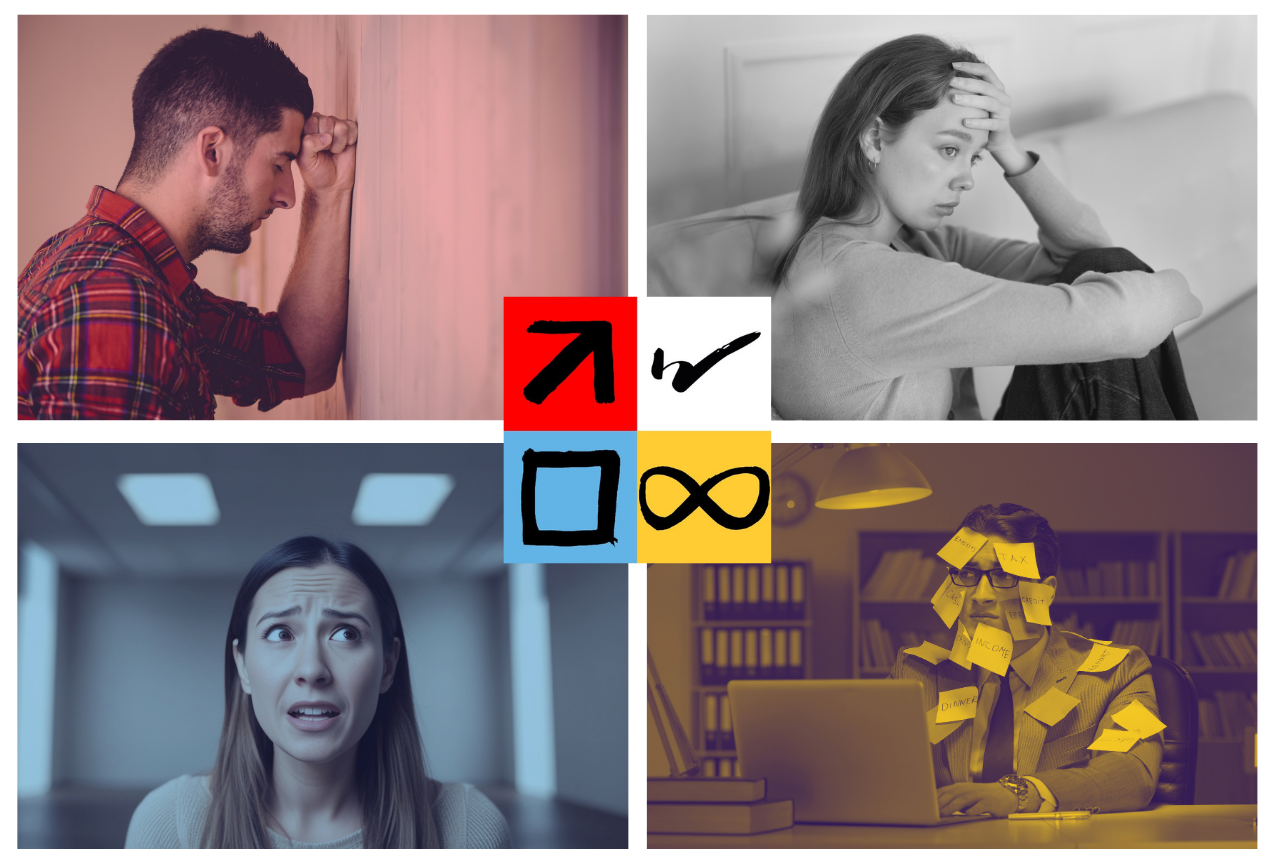
Stress signatures are written in the language of four patterns in our nervous system. Fortunately, there’s a pattern antidote to every one of them. Credit clockwise from upper left: Wavebreakmedia (Getty), Faalguni Mandal, Elnur, Sumali Ibnu Chamid (from Alemedia.id) and the FEBI pattern icons in the center are registered trademarks of the Institute for Zen Leadership, used with permission.
By Ginny Whitelaw
Originally published on Forbes.com on October 1, 2026.
Behind schedule and with mounting pressure to deliver, Jack pushes harder on himself and others. Susan tightens and ticks through her list, controlling what details she can. Rob gets dramatic or cracks a joke but doesn’t know where to start. Val dissociates from the pressure, as if floating above it, and may swoop in with a solution or may not.
Each of these stress responses is characteristic of a particular pattern in our nervous system. These patterns, also called FEBI energy patterns based on the assessment that measures them, are known as Driver, Organizer, Collaborator and Visionary. They underlie personality, coordinate movement and give rise to specific emotions, thoughts and behaviors. While we all have access to all four patterns, we also have preferences, including a likely default pattern we resort to under stress. At a time when more than 70% of leaders say their stress levels are increasing, it’s good to know one’s default reactions. It’s even better to recognize when those defaults are not helpful, and best to know how to change them.
Even for people who mostly live in their heads, stress can make the mind-body connection painfully obvious. Chronic stress is associated with elevated levels of cortisol which, in turn correlate with hypertension, weight gain, weaker immune response, and slower recovery times. It’s estimated that 75-90% of the illnesses treated by primary care physicians have a stress component.
Unlike most models of personality, the FEBI energy patterns also make the mind-body connection obvious, which makes them particularly useful for understanding and shifting one’s stress signature. The four patterns arise in the body as four ways to coordinate the opposing muscle groups that make every movement possible. They also relate to where we hold residual tension, particularly in our flexor-side muscles.
If we represent flexor muscles as “A” and extensor muscles as “B,” there are four ways A and B can work together.
A before B
A and B at the same time
A and B alternating
B before A
What’s striking is that each of these states feels different and gives rise to different thoughts, emotions and behaviors. You can get a sense of those differences by bending your arm four different ways as guided below. In this case, the biceps and inside of the arm are the flexor muscles, A, and the triceps and back side of the arm are the extensor muscles, B.
A before B: Start by tensing your biceps (i.e., “making a muscle”) then push against that pressure to bend your arm, bringing your wrist toward your shoulder. This is the Driver pattern that centers on pushing. You might notice it comes with feelings of determination, intensity and singular focus.
A and B at the same time: Shake that out. Hold your arm straight and feel its inside and backside equally. Begin activating both sides exactly together as you bend your arm. This is the Organizer pattern that shapes and holds form. Feel the orderliness and precision of the movement. You might notice this pattern is less intense than Driver and comes with a sense of doing things just right.
A and B alternating: Shake that out. Straighten your arm and then gently activate the inside, then the backside, inside, backside, as your wrist progressively makes its way toward your shoulder. This is the Collaborator pattern, whose essential movement is rhythmic. You might notice a kind of ease and playfulness to it. From handshakes to rocking a baby, this is also the pattern that readily connects people.
B before A: Shake that out. In the most relaxed way possible, extend your arm out through your fingertips. Imagine energy flowing out through your fingertips and, keeping that sense of extension, gently redirect that energy toward your shoulder. This is the pattern of Visionary, which centers on extension or expansion. You might notice it has a quality of ease and extension.
Resourced by these four mind-body patterns, we have not only a useful framework for understanding our stress reactions, but ready ways to shift out of them. Here are ways to recognize the stress signature of each pattern and along with an antidote.
Driver Under Stress
When the going gets tough, the Driver pushes harder. Under pressure, this pattern tries to control the situation with speed and urgency, often with rapid-fire orders and putting greater pressure on others. Driver’s single-point focus makes them certain of whatever they think and their desire to win can blind them to the cost. Physically, the Driver’s excessive pushing can show up as high blood pressure and tight muscles.
The Antidote—Visionary: When pushing is only digging the hole deeper, pause. Let go and enter the Visionary pattern. Rub your forehead and then let your hands drift out from each side of your head, seeing them both in your peripheral vision. Staying with the soft focus of this 180-degree vision, feel the extensor side of both arms and imagine energy streaming out through your open palms and fingertips. Feel energy streaming through your back and spine and out the top of your head. If possible, step outside and let your vision expand to the entire dome around you. Open yourself to nature and, if you wish to add movement, let it be like the wind moving through you, carrying off any tightness. From this state, sense the larger dynamics in the situation and creative ways to approach it.
Organizer Under Stress
When workload and deadline pressures mount, the Organizer holds rigidly to lists and plans, trying to control the disorder as much as possible. Prone to worry and anxiety, the Organizer pattern under stress can put form over substance or get stuck in self-justification or self-criticism. Physically, the Organizer’s excessive efforts to bring order to chaos show up as rigidity in the body, often accompanied by tightness in the torso and respiratory problems.
The Antidote—Collaborator: When buckling down starts making you buckle under the weight, it’s time to find rhythm. Start rocking side-to-side in your chair or, better yet, stand up and shift your weight from one foot to another, sloshing from side to side. Let your head go as well and bring your arms into it, making big, sloshing figure-8’s, like a wave in a bathtub. To add to the fun, you could put on the sort of dance music that makes you want to shift weight or swing on the beat and take a few minutes to just feel this playful energy flow through your body. From this state, feel into how you could bring a healthier rhythm into how you’re working and who could help. Even taking Collaborator mini breaks like this will bring a healthy rhythm to the relentlessness.
Collaborator Under Stress
When the plate gets too full, The Collaborator often doesn’t know where to start. It all seems so impossibly run together, so why not change the subject, make a joke, grab a candy bar, or gossip with a colleague? The Collaborator pattern under stress tends to become more chaotic, distractible and dramatic. Physically, the Collaborator pattern centers in the abdomen and stress in this region can show up as dietary and digestive issues.
The Antidote—Driver: When you don’t know where to start, cut through with the Driver’s clarity to set priorities and get stuff off your plate. To start, clasp your hands together, extending your index fingers. Press your hands toward one another, press your big toes into the earth, and feel how that activates the base of the abdomen. Bringing your hands up to eye level, sight down your extended index fingers as if you were lining up on a target and feel your eyes come to a beady focus. Ask yourself, what’s the top priority? Clear your desk or workspace of clutter or potential distractions, leaving just the one thing you need to focus on now. Keep the Driver close as a kind of protector to cut through distraction before it carries you away.
Visionary Under Stress
Amidst so much pressure, so many dynamics at play, so many people running this way and that, the Visionary takes refuge in their happy place, which may be far, far away. The Visionary pattern under stress can disconnect from what’s going on and be an unreliable player in facing it. They may have glimmers of solutions and good ideas but have a hard time expressing them or getting others to listen. Physically, the Visionary pattern has the quality of expanding or extending, but this can also mean drifting off or dissociating.
The Antidote—Organizer: When you’re drifting about too high in your head, you need the grounding of Organizer. Like the earth, it gives something to stand on, to give form to your ideas and parse them in ways that others can understand. Start entering Organizer by rubbing down your arms, torso and legs, feeling the form of your physical body. Standing tall, stack your body in gravity, aligning hips over feet, shoulders over hips and ears over shoulders. Feeling the dignity of your full length, place (but don’t press) one palm on top of the other at the level of your solar plexus. Moving from this center, step forward with one foot and draw up your back leg. Take a step back and draw in your front leg. Step to one side, draw in, and then to the other. Continue in this stepwise fashion holding the question of how you might organize your ideas or take some well-grounded next steps.
The FEBI energy patterns work harmoniously as a system, each one able to mitigate the stress reactions of another, so that we don’t stay stuck. The antidote pattern offered in the examples above is not the only pattern we might use, but it’s a good first choice. In general, if we’re stuck in the more controlling patterns of Driver or Organizer, we do well to shift into the more connecting patterns of Collaborator or Visionary. If we’re lost in the confusion or chaos of Collaborator or Visionary, the more structured and structuring patterns of Organizer and Driver can come to the rescue.
The more we play with and enter each pattern consciously, the more available they become unconsciously to help us shift when our default pattern is struggling. It’s good to know and use our strengths, for sure. It’s even better to know when those strengths become stress-induced weaknesses. And what’s best is the capacity to shift into another pattern that not only feels better but better meets the moment.
Ginny Whitelaw is the Founder and CEO of the Institute for Zen Leadership.