
Zen and the Art of Healing
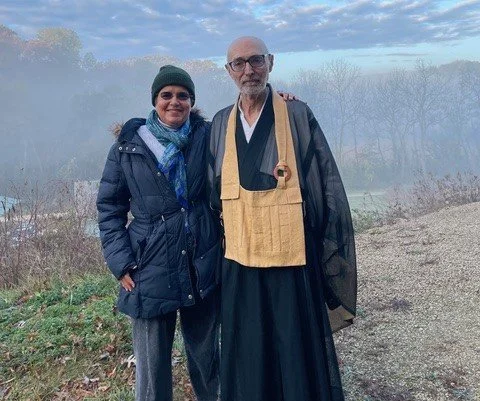
Cynthia Haq and Ken Kushner Roshi, Photo Credit: John Frey
Written by Cynthia Haq, MD; Kenneth Kushner, PhD, July 18, 2025
If you’re curious, here is a story about how Zen training might enhance practice and teaching.
Several years ago, I was sitting quietly in the teaching room of a busy urban clinic when Dr. Sarah, a family medicine resident, entered and announced in a loud, pressured voice, “I don’t know what to do with this patient.”
As the attending or supervising physician, my role was to guide residents to become independent physicians. I tried not to jump to answers, but to help residents find their own ways to deliver the best patient care. “Tell me more.” I asked. Dr. Sarah went on, “The patient is a 32- year-old woman recently released from prison. She isn’t speaking.”
I wasn’t sure what to do, so I took a deep breath and joined the resident to return to see the patient. As we walked towards the patient’s room, I noted clinic staff speaking in hushed voices in the corridors. I paused at the exam room door, took another deep breath, cleared my mind, and knocked firmly to announce our arrival.
Florence (not her real name) was a slight woman lying curled in a fetal position on the exam table with her head facing the wall. I sat down quietly and gestured for Dr. Sarah to do the same. After a few moments I sensed the patient’s body relaxing. I spoke softly and introduced myself, “You are welcome here. How can we help you? Please share your concerns.” She barely stirred but moved enough to signal she heard me. I continued to sit and took slow deep breaths. I continued, “It is hard to start over with a new clinic and doctor. It will take time for us to get to know each other. You can stay as long as you need. You can talk to us when you’re ready.”
After I left the room, the clinic staff were agitated. They asked me, “Do you know who she is?” I didn’t, but a quick computer search revealed the facts. The patient had been addicted, left her toddler alone in the bathtub to obtain drugs, and returned to find her child drowned. She was convicted of neglect resulting in her child’s death and sentenced to years in prison. This was her first clinic visit since her release.
The resident and I brainstormed next steps. Florence was living in a group home, severely depressed, feeling totally unworthy, without motivation, and unemployed. While stunned by the tragic outcome of her neglect, we knew the power of addiction. Without support, she could soon be back on drugs and on the streets. I reminded the resident, “This patient is a human being worthy of our care and compassion. We don’t define anyone by the worst thing they ever did.” Her recovery would take time.
Remarkably, Dr. Sarah established a therapeutic relationship with the patient. The patient was linked to social services, started on antidepressant medications and psychotherapy.
About a year later, I noted Florence’s name on the clinic schedule and went into her room to say hello. She was sitting upright and seemed to have been transformed. She proudly shared how she had completed vocational training, was working at a new job, and had her own apartment. She was on the path of a new life.
Reflections from a Practitioner:
How did Zen training help prepare me for this encounter? First, as an experienced family physician, teacher, and Zen practitioner, I was dedicated to work where the needs were greatest. I chose to teach and practice in a health professional shortage area and to work in neighborhoods among people who lived on the lowest incomes in our state. This area had been troubled by decades of segregation, disinvestment, and high rates of poverty, crime, violence and drug addiction. I was deliberate in my choice of a teaching and practice site.
Earlier, I had completed the Therapeutic Stance, a workshop started by Zen priests or Roshis Kushner and Greene, who taught the principles of Zen to health professionals. At the time, I didn’t take much stock in breath and posture. Aren’t we always breathing? Nevertheless, we practiced how to breathe very deeply and slowly, to sit, walk and knock deliberately, to pause at the exam room door, and to take a deep breath to clear our minds before interviewing a patient.
Through daily Zazen practice or meditation, I learned to use my breath and posture to tame my monkey mind, to become more aware of internal bodily signals, and to notice the non-verbal cues and energies of others. Zen enabled me to hone my skills in the art of medicine which requires fine-tuning communications and relationships. These skills include heightened bodily and emotional self-awareness; and noticing and responding to the trainee’s or patient’s cues. Zazen helped me protect space for the pause; to use my breath and posture after the stimulus and before my response.
When I sensed the resident doctor’s distress, I felt a knot of pressure at the base of my sternum which signaled fear in my body. Initially, I froze and wasn’t sure what to do. Zen practice signaled my body’s need to pause; it reminded me to return to my breath and posture which are always available. The pause and deep breath calmed my nervous system. In the pause, I found space and time to restrain my impulses to jump to conclusions or to react too quickly. I paused and took another deep breath before I entered the patient’s room, especially since I didn’t know what to do.
Addiction is a disease that hijacks the brain and takes over other behaviors, even a mother’s instincts to care for her own child. The pause enabled me to notice, listen deeply, grieve, and imagine how Florence could live with the burden of her addictive behavior that took the life of her own child. This pause enabled me to see her humanity and to treat her with dignity. The pause enabled me to sit quietly until the patient was ready, to listen deeply as the resident expressed her fears, and to gently guide the team towards compassionate actions.
Zen practices enable me to sense and use my body, breath and presence as a vehicle for healing. After noting the benefits, I now pause, take a deep breath, and clear my mind whenever I prepare to enter a patient’s room. During each sacred doctor-patient encounter, for each patient who has entrusted me with their life, they are the most important thing in the world. Zazen provides practice, self-discipline, and muscle memory to put aside all other things to be fully present.
Reflections from a Zen Teacher:
I’m grateful that Cindy asked me to write a commentary on this case. I’ve known her for many years and in many different roles: first as one of her teachers in the University of Wisconsin family medicine residency, and later as a colleague and friend. She was in the first cohort of the Therapeutic Stance workshops (now called HEAL) that Gordon Greene and I led for many years. Cindy has always been a role model of compassionate care, and I’ve learned so much from her over the years.
The case she describes is one I think most clinicians can relate to. She and the resident suddenly found themselves face-to-face with a patient whose history could easily stir up all kinds of complex emotions—probably made worse by the reactions of the staff. But Cindy was able to “hold back my impulses to jump to conclusions or react too quickly.” That allowed her to create a safe, non-judgmental, healing space for the patient, and also a valuable learning moment for the resident. Cindy credits her Zen training for helping her create that space. I’d like to share my perspective on the kind of training that makes that possible.
The key to understanding the Zen element of Cindy’s approach lies in that moment when she stopped to take a few deep breaths before knocking on the exam room door. At first glance, that might not seem like a big deal. After all, in our culture we often tell people to pause and take a deep breath. But there are deep breaths… and then there are DEEP BREATHS. And in our Zen tradition, we train specifically in the latter.
In our Zen tradition, we don’t call what we do “mindfulness.” One thing that sets us apart is how much we emphasize the physical aspect of practice, especially in zazen. That emphasis is summed up in two Japanese sayings. The first is: “You can’t wash off blood with blood.” In other words, it’s hard to control thoughts with more thoughts. The second is: “Enter the mind through the body.” Together, they mean we work with the mind by working through the body—specifically through breath and posture.
Rather than just observing the breath, we train in a specific kind of breathing called hara breathing. Hara is the Japanese word for the lower abdomen. Hara breathing isn’t the same as ordinary abdominal or diaphragmatic breathing (what’s often called “belly breathing”). With hara breathing, the lower abdomen stays gently expanded whether you’re inhaling or exhaling. It takes some time to learn, but it’s well worth the effort. I’m sure that when Cindy stopped to take a deep breath before entering the room, what she really took was a deep hara breath to center herself for what lay ahead.
Hara breathing does more than just calm you down—it helps generate a state of mind–body integration known as samadhi. Samadhi doesn’t have a single, perfect English translation. People sometimes call it “concentration,” “relaxed focus,” or “absorption.” Samadhi allows you to give your full, undivided attention to the person in front of you. And, samadhi is contagious: It has a calming effect on other people. In our tradition, the quality of your samadhi is directly tied to the quality of your hara breathing.
In our HEAL workshops, we not only give instruction in hara breathing, but we teach how to bring it into the exam room. One of our basic exercises involves teaching participants to take a deep hara breath before entering the exam room and how to maintain samadhi once inside. That facilitates the creation of a healing space.
It’s a testament not just to Cindy’s skill and dedication, but to the lasting value of this kind of teaching and practice—and a reminder that even a few deep breaths, taken with intention, can change everything.
Cindy Haq, MD, serves on the IZL Board of Directors and has helped to develop its HEAL program. She is Professor Emerita of Family Medicine at the University of California, Irvine.
Kenneth Setsuzan Kushner founded the forerunner of Chosei Zen (formerly Chozen-ji Betsuin/International Zen Dojo of Wisconsin) in 1982. He is the Abbot Emeritus of Chosei Zen and a priest based at Daikozen-ji. Kushner Roshi is a Professor Emeritus in the University of Wisconsin’s Department of Family Medicine and Community Health.