
A Somatic Invitation to Lead in Low-Trust Cultures

Over the long weekend, I watched With Love, Meghan. I was curious what it looks like when a woman leads with sincerity in a world that has already decided not to trust her.
There is something quietly brave about extending your core self into a room that has been trained to doubt it. To offer eye contact and warmth when the culture is still bracing for the next disappointment. And yet, what stayed with me wasn’t her composure. It was the familiarity of the tension. What happens when a high-trust leader enters a low-trust room?
I’ve seen it in coaching rooms and boardrooms alike. Leaders arrive with clarity and good intent only to find those gifts landing with a dull thud. It’s not rejection exactly. More like, the room is skeptical. Not hostile. Closed, not cruel.
Because the culture remembers. It remembers the last reorg. The last promise that wasn’t kept. The last leader who led with vision but not follow-through. So when a new leader walks in offering trust, the system doesn’t know what to do with it. It flinches.
In the realm of Zen, we are taught to sit with paradox. Not to resolve it. Not to fix it. Rather, to inhabit it fully. Two truths can be real at once.
And yet when we picture leadership, we often imagine moments of high drama or decisive action. But in truth, most leadership unfolds in the quieter, more chronic tension of “or.” Not crisis, but pattern. The unconscious splitting that happens in day-to-day interactions:
Do I fight ‘or’ flee?
Do I speak ‘or’ stay silent?
Do I stay strong ‘or’ become soft?
Do I act now ‘or’ wait?
Do I serve the business ‘or’ serve the people?
This is the grip of “or.”
“Or” is the mind’s way of creating safety. Neuroscience and trauma research show this is also the body’s way of shrinking when it doesn’t know how to hold complexity. “Or” lives in the neck and jaw. In tightening, narrowing, making decisions too fast. It’s the somatic signature of urgency. A nervous system seeking resolution by forcing one part of you to win and the other to disappear.
But the wisest leaders I know have made the flip.
A coaching story: When “or” wasn’t enough
Maya, recently promoted into a global VP role, brought with her a track record of thoughtful leadership. She was known for her follow-through, her warmth, her ability to build trust through consistency. But the team she inherited had endured three leadership changes and a failed strategic pivot within 12 months. They were tired. Wary. Watchful.
Maya led the way she always had: with openness and responsiveness. She asked questions. Offered ideas. Reached out in good faith. And… nothing. Her emails got the bare minimum. Her meetings were quiet. Her energy, once motivating, now seemed to dissolve in the room.
"I’m doing everything I’ve always done," she told me, "but it’s like the room is coated in wax."
Her early attempts to connect — Slack messages, collaborative planning, space for feedback — were met with distance. No active resistance. Just a polite, unmoving surface.
"This isn’t hostility," she told me. "It’s polite withholding. And it’s starting to wear me down."
Her instinct, understandably, was to ask: Do I keep showing up this way, or do I harden? Do I stay open, ‘or’ do I match their distance? But this framing kept her trapped. Because it assumed she had to choose between authenticity and adaptation, between trusting and protecting.
The polarity trap: Inner trust vs. outer skepticism
When Maya began to question her own instincts —whether to stay open “or” to retreat— what she was facing wasn’t a simple decision. That binary is seductive because it offers clarity in ambiguity. But it’s also false. What a leader is facing isn’t a fork in the road. It is a polarity: two values that seem to oppose each other but are actually interdependent. Inner trust and outer skepticism aren’t at odds. They coexist in any real system.
Trust allows for collaboration, connection and results. Skepticism offers caution, self-protection and results. When one dominates without the other, something skews. So instead of asking: Which one is right? A more useful question might be: What is each side protecting? What’s the cost of staying too long in one? And how might I move between them more fluidly?
That’s where the Zen flip begins.
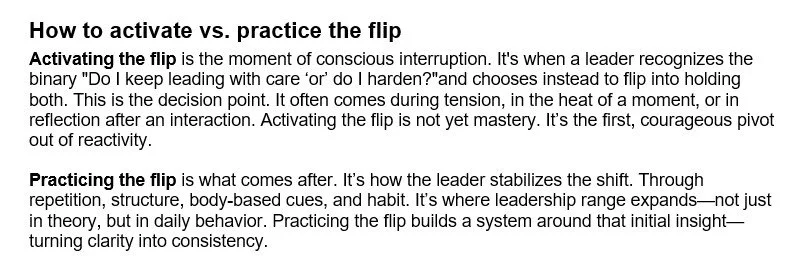
How to activate the flip: From “or” to “and”
This is not a metaphor. It is a somatic and strategic maneuver leaders can learn to make. Not once. Repeatedly. It begins when the body can hold contradiction without collapsing.
We first used a somatic and cognitive protocol to help Maya make this real.
Step 1: Locate your default position
For Maya, it was the upside of inner trust. She believed in people. She defaulted to empathy. She initiated connection, which got her results.
Step 2: Feel the cost of staying there too long
We explored the downside of that pole. For Maya, it was exhaustion. Emotional over-functioning and a dawning that she was forcing her warmth on others.
Step 3: Acknowledge the wisdom of the other side
The team wasn’t wrong to be cautious. Their restraint wasn’t rude. Maya started to see it as residue from unmet promises and rapid turnover. Their silence was their way of staying safe while getting results, however limited.
Step 4: Clarify the downsides of the other side
Maya started to objectively see that the team’s guardedness had an opportunity cost. Slowed collaboration and emotional disconnection were limiting innovation, team growth and organizational outcomes.
In our coaching session, we mapped the polarity Maya was in:

Mapping her polarity while examining the competing forces she was facing gave Maya a way to see the full system — her part and theirs. But insight wasn’t enough. To shift her leadership in practice, she needed to go deeper into the body.
How to practice the flip
We used somatic intelligence to build Maya’s internal muscle to hold contradiction with clarity. This habit building protocol had three steps:
Pause when you feel binary tension. Instead of rushing to soothe yourself and others, imagine you are at a red light at a cross road. Notice where "or" is living in your body. Clenched jaw? Narrowed gaze? Racing thoughts?
Next, breathe into the opposites. Visualize both truths. Let your breath widen in your diaphragm to accommodate both. From neuroscience, we know that when the breath deepens, the prefrontal cortex re-engages, restoring access to nuanced thinking, emotional regulation, and perspective-taking. What seems like a small shift — one deeper breath — is, in fact, a neural intervention. The body stops bracing. The mind becomes more flexible. And the system becomes capable of holding paradox.
Speak the "and" aloud: I can care… and set limits. I can lead… and not be received. I can hold my values… and adapt my rhythm. Let these phrases settle not just in your mind, but in your breath and bones. They aren’t affirmations. They are somatic reminders that both can be true and that you are big enough to hold them.
Three actions Maya took
Once Maya had mapped the polarity and activated the flip, we explored what it would look like to lead differently without abandoning herself or matching the team’s guardedness. She identified three actions that translated inner clarity into outer rhythm:
Shift into the opposite energy deliberately: Maya began practicing Organizer energy (from FEBI) and leaned into clear boundaries, concise language, structured communication. She stood up, dropped her breath into her hara, shortened her sentences, removed qualifiers like "maybe" and "just," and allowed silence after each sentence. Her body told the room: I will not overwhelm you with warmth. I will meet you where you are.
Integrate using clear signals: She began sending small, predictable signals such as sending agendas in advance, giving feedback only in 1:1s, and keeping tight timelines. She didn’t stop being trustworthy. She instead understood the waters she was swimming in and began tailoring her trust superpower for short-term safety and long-term results.
Calibrate without collapsing: The hardest part wasn’t shifting. It was staying there. Maya built in weekly reflection to notice when she started over-functioning again. She created a simple journaling ritual: What did I carry that wasn’t mine? What did I offer that was actually received? What structure might serve instead of more energy? This third step became her anchor.
Why this matters
Most leadership advice would have old Maya to "read the room" or "earn credibility through results." Fine. But incomplete. What she needed wasn’t better advice. She needed a map. One that showed the full terrain of her leadership not just where she liked to lead from, but where she was being asked to grow.
The flip from "or" to "and" gave her that map. Polarity management gave her the system. Somatic tools gave her the access point. What emerged was not a different person. It was a fuller leader and one who could hold contradiction without losing ground.
And the team? They didn’t change overnight. But they began to re-engage. Not because she convinced them. But because she gave them what they needed to observe consistency before offering trust.
Zen doesn’t talk much about balance. It speaks of emptiness, not as void, but boundlessly large enough to hold complexity without forcing resolution. A kind of sacred middle.

Explore how the Institute for Zen Leadership helps leaders shift from coping to transforming or if you’d like to speak with someone about our programs, contact us.
Visit here to learn more about Archana Bharathan.