
Zen Leadership: Lighting The Spark Of Practice That Sets It Apart
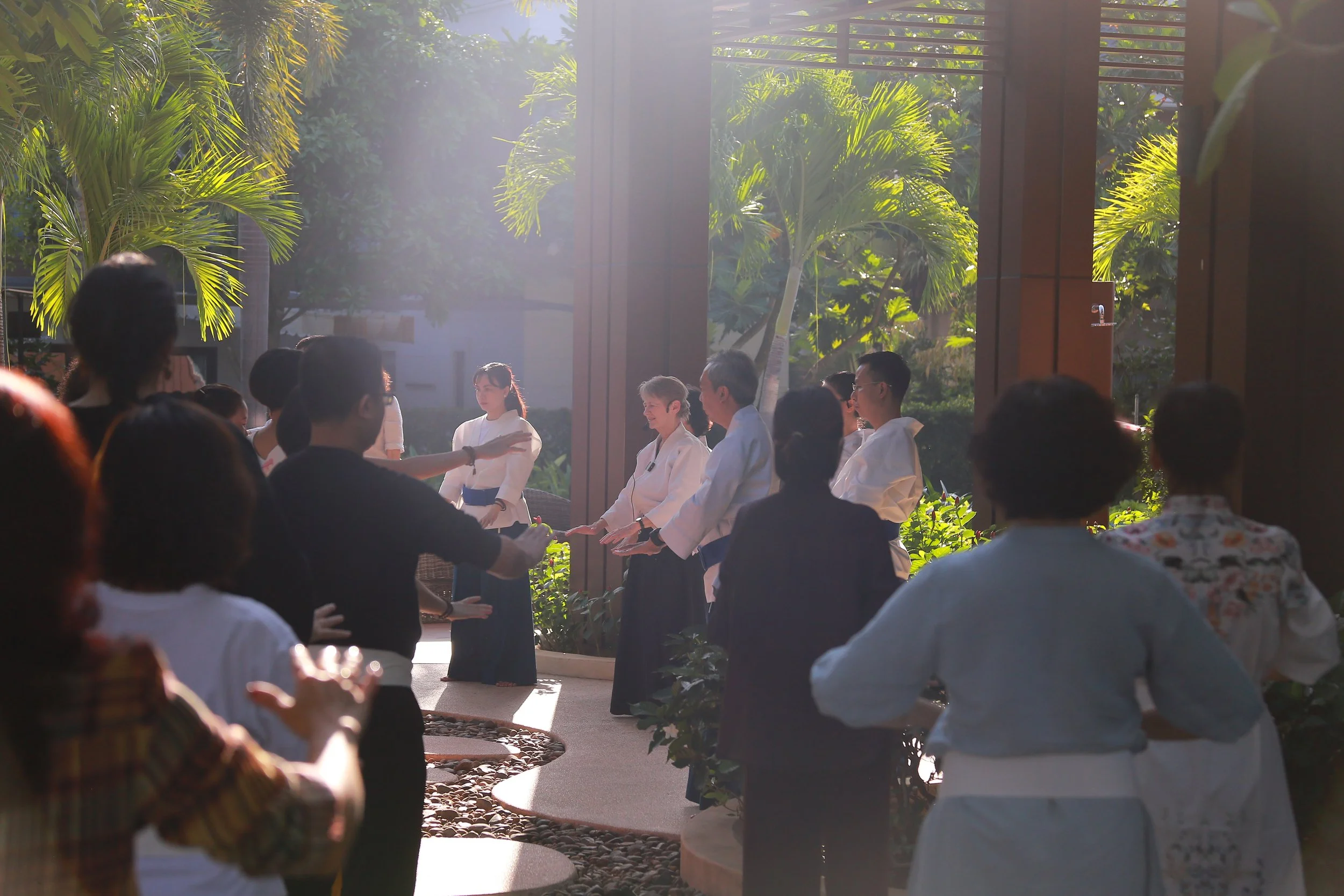
Starting the day hara-first: morning breathing practice with the Zen Leadership group in Vietnam. Credit: LLO and IZL photo archive.
By Ginny Whitelaw
Originally published on Forbes.com on April 1, 2026.
Nguyễn Phùng Phong, who also goes by Kenny is a leader and educator in Vietnam. He started working with memory and learning techniques in 2014 and, two years later, became a World Championship Memory Record Holder. The following year, he became the Head Coach of the Vietnamese Memory Team, which went on to win further world championships under his guidance. He helped establish the Vietnam Memory Organization and founded the TTL Education Group, where he has scaled his methods to reach not only world-class competitors but hundreds of thousands of schoolkids. Within a decade he made Vietnam a world leader in memory techniques. Recently he was among more than 100 leaders in Vietnam who took part in Zen Leadership training organized by Helen Nguyễn Thị Thanh Huong and her company, Liberal Leadership Organization, LLO*. Recounting his experience, he said, “I’ve taken countless leadership courses and can memorize them from beginning to end. But not this one. This is different; it takes practice.”
In a nutshell he summarized what sets Zen Leadership apart from other forms of leadership training, or anything that can be posted on a placard of values, a list of tips, or a trendy book. This man, who could intellectually learn anything, recognized that this was a different kind of learning. The learning of Zen and, by extension Zen Leadership, happens at the pace of the body, that is, the rate at which new neural pathways can form, connective tissue can heal or free up, muscles can relax, and bones can re-align in gravity. It evolves at the pace where new habits take root, breath deepens and slows down, and a new rhythm of coherence emerges between head, heart and the critical center in the lower abdomen, hara. Zazen, or sitting meditation is a key practice for this learning, along with training that develops hara-centered breathing, an aligned, relaxed posture, and embodied leadership skills.
In the time it takes the body-mind to reintegrate with this deeper kind of learning, the head can generate countless thoughts, worries and ideas. Which ideas do we act on? Which worries do we take seriously? What do we simply have to accept? Fortunately, the deep learning that leads to inner coherence supports us in telling the difference. Needless mind chatter arrives with a different felt sense than a message from hara. Inner coherence with hara allows us to be calmly centered, engage power and action if we need to, and hear a source of wisdom beyond ego, answering Niebuhr's Serenity Prayer, "God, grant me the serenity to accept the things I cannot change, courage to change the things I can, and wisdom to know the difference."
The courage to change what things she could is exactly what allowed Helen to re-ignite Zen Leadership in Vietnam. As she puts it, “Zen Leadership has given me something I did not have before: the ability to stay with fear, not be stopped by it, and to act from a deeper place of alignment and trust. Bringing Zen Leadership to Vietnam was once just a quiet seed. Through this work, I have come to see more clearly who I am, what I am here to serve, and how to lead from courageous love.”
And there’s more. By engaging the deeper, slower training that builds inner coherence, we increasingly dance with the rhythms of life and build outer coherence with our teams, organizations and communities. A Zen Leadership instructor in Vietnam, Phạm Duy Hiếu, former CEO of ABBank, applied this principle when developing the bank’s customer growth strategy. While many proposed various actions, on a weekend morning, he chose a quiet café, held stillness, centered in the hara, and opened to nameless intuition without expectation. One hour passed. Two hours passed. Around 9 AM, a call came in asking whether ABBank could provide products and services to support community rebuilding. Had he not been there, that opportunity might have gone to another bank. From that one call, an opportunity opened up for the bank to triple its number of customers.
Another Zen Leadership faculty member, Le Ba Thong, who founded and led TTT, a major architectural firm in Vietnam, found this principle of inner coherence leading to outer coherence in how he worked with his teams. He prioritized well-being and happiness in the workplace, which meant people were coming to work in a more coherent state and able to get on the same wavelength with teammates and clients. Moreover, their projects came together more coherently and beautifully, including most of the 5-star hotels in HCMC.
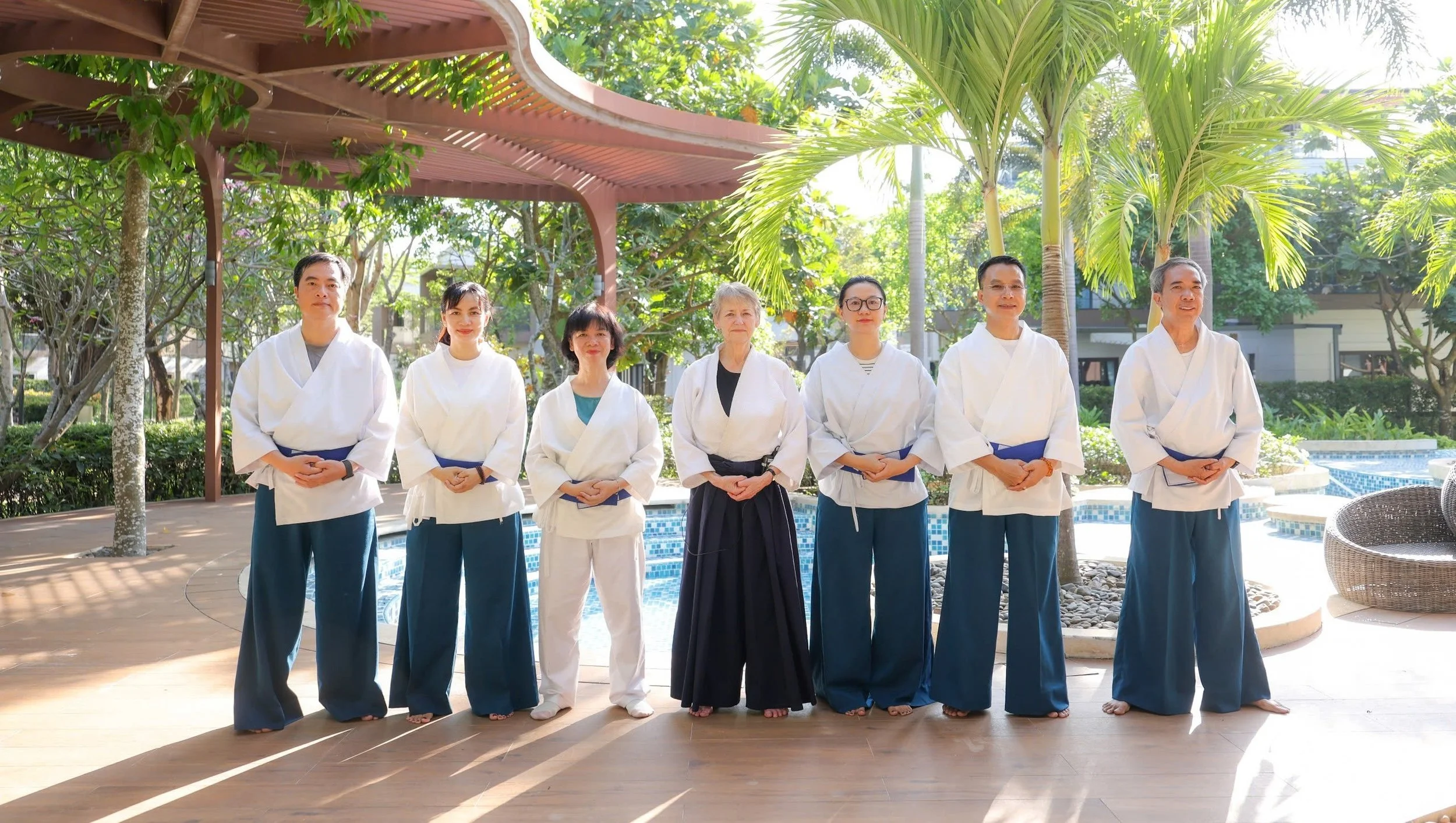
Helen Nguyễn Huong, third from left, founded LLO to ignite the practice of Zen Leadership in Vietnam. Joined here by the faculty team leading recent programs, from left: Phạm Duy Hiếu, Tran My Hanh, Helen, Ginny Whitelaw, Nguyen Bao Tran, Dam Duc Anh, Le Ba Thong. Credit: LLO and IZL photo archive
The reframing flips of Zen Leadership are designed to ultimately reframe the ego itself. They begin with flipping the body’s tension to extension and resistance to acceptance. As the body relaxes and energy flows more freely, “I” is better able to roll with the punches, facing things as they are, not as “I” imagines or desires. Working through more Zen Leadership flips, “I” becomes more agile, able to hold multiple perspectives, become the other, or use any of four energy patterns in the nervous system as best fits the situation. Finally, in connecting with hara, “I” connects with a primordial aspect of our being—our very ground of Being—that served us before we even formed an ego “I”.
This hara-centeredness, combined with increasing depth in meditation (i.e., samadhi), makes the ego more porous and translucent until we see through it altogether. Yes, we need an ego, we’d be crazy without one. But it’s not the totality of who we are and its sense of separation is a delusion. Reading these words won’t save anyone, but the physical experience they describe changes everything. Suddenly the ego flips from being a tyrant trying to get its needs met to being a tool in service of life. Leadership from this place accords the Way in a spiritual sense, which the head interprets as leading true to one’s purpose. It is the happiest, most satisfying and effective way to lead.
To underscore the physicality of Zen Leadership training, Helen and her team provided a swag bag to all participants that included a hara belt. Made of sturdy cotton, about 8 cm or 3 inches wide, fastened with Velcro, a hara belt is worn low, below the navel. It provides bio-feedback as to when movement of breath is properly regulated from hara. Participants were shown how to wear and use the belt and, over the course of the 2-day program, virtually every participant shared some experience of how increased hara centeredness and awareness had helped them. One participant said it helped him quiet down inside so he could listen more readily to others. Another shared that it helped her clear an issue that had long been troubling her heart because she felt a deeper courage from hara. So, while Kenny is correct that learning in the body takes practice, benefits begin from the start.
Helen and her team at LLO have ignited the spark of Zen Leadership practice in Vietnam. If leaders like Kenny master this practice with the same vigor with which he mastered learning in the head, within a decade Vietnam could well be a world leader in Zen Leadership.
*LLO is the Institute for Zen Leadership’s (IZL’s) partner in Vietnam and the author is the founder of IZL.
Ginny Whitelaw is the Founder and CEO of the Institute for Zen Leadership.