
On the “Fundamental Point” of Hara Solidarity
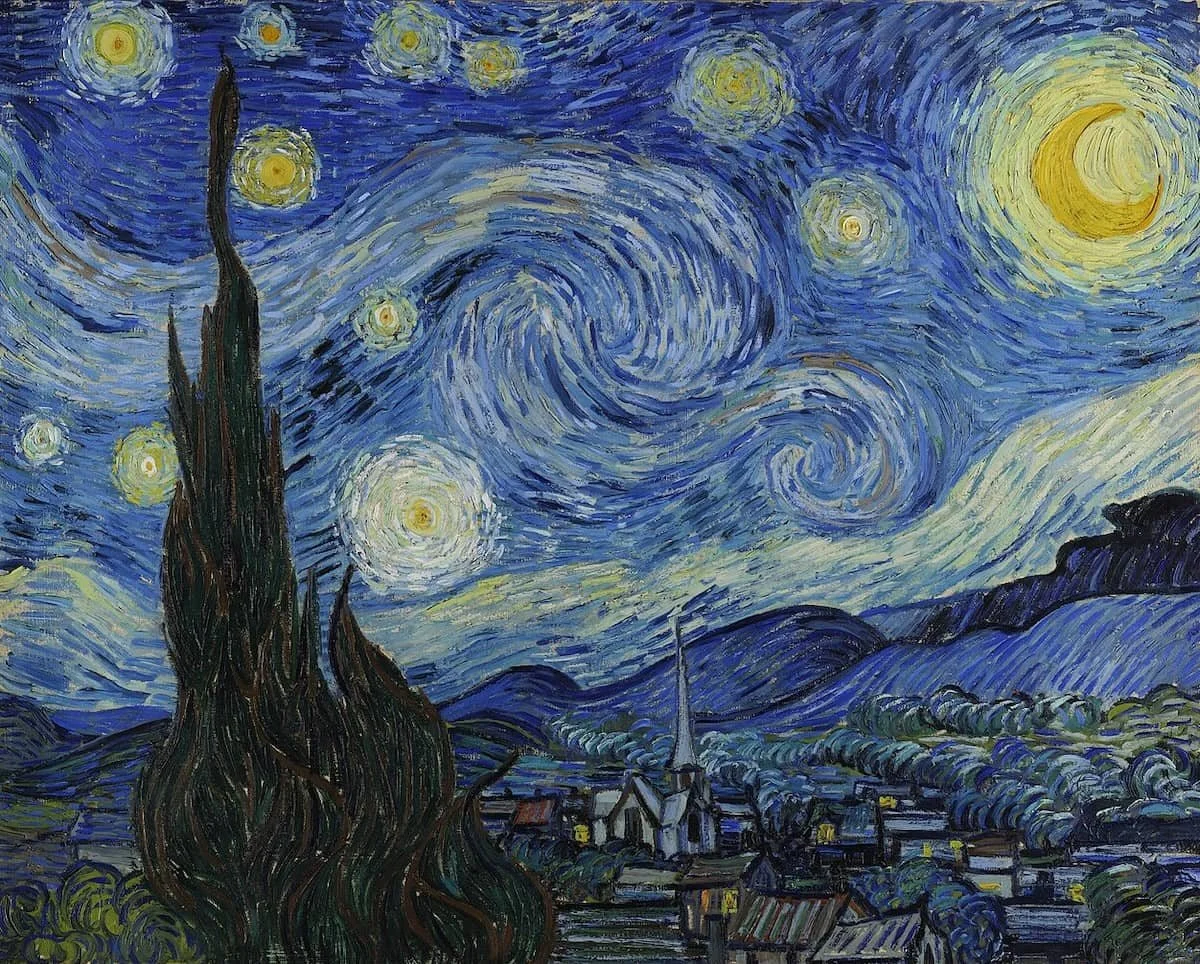
Vincent van Gogh, The Starry Night, 1889
Written by: Shawn Kimmel
There are no bodhisattvas in separation from sangha;
There is no sangha without bodhisattvas;
This is the fractal interbeing of hara-solidarity.
At the hara-rooted source of our Zen tradition stands a fundamental question posed to the Buddha: “If a noble son or daughter should set forth on the bodhisattva path, how should they behave, how should they practice, and how should they discipline their thoughts?”
To this question the Buddha responded: “Those who would now set forth on the bodhisattva path should think this thought: ‘I shall liberate all beings.’”
Thus begins the narrative dialogue that has come down to us as the Diamond Sutra, originating more than two thousand years ago, which tells us two primary things:
1) People were asking then what they continue to ask now in the face of human suffering – What are we to do? How should we behave and practice and think in the face of suffering?
2) The answer to this question does not come easily for humans, and yet is always immediately accessible to each of us, just as much now as then – through the concentrated, disciplined focus of a bodhisattva.
I ask this question repeatedly and perpetually these days as I sit in zazen and breathe into the face of the suffering and death being deliberately inflicted on our fellow human beings across the world (through the abrupt cut-off of U.S.A.I.D. funding), and on our immigrant neighbors across the states, by a U.S. governmental regime that has closed itself off from the most basic common sense of mutual responsibility or solidarity with all beings on our planet.
And I wrestle with Buddha’s answer to this question in full recognition of the fact that because this is our government, we (in the States) are all responsible for what is happening with it. And so the questions of what are we to do, and how are we to behave and practice and think in the face of this human suffering become deeply, directly, and unavoidably not just spiritual questions, but also questions of politics: What has gone so deeply wrong with the politics that we have all been part of co-constituting together? And what can we now do about this, if we are not simply to bow down to accepting this politics of fundamental violence against all beings as inevitable?
Our Forgotten Solidarity
As “civilized” humans – even in many of our most “spiritual” communities – we have long lost touch with our deep solidarity, and in that loss have forgotten how our existence is constituted only through our mutually interdependent relationships with all beings of the Earth, including our fellow human beings. And this core forgetting is the root of all our suffering, both spiritually and politically.
This forgetting is not simply the forgetting of the meaning of any words or concepts such as “solidarity” or “Being,” as some philosophers would suggest. For the words are not what ultimately matters. What matters is the deep forgetting of the practices that connect us to the enabling power indicated by words like these. What matters is the enacting energy of what the ancient Greeks called praxis, to signify the originary power of collective human action that comes into being only when individuals step out beyond the enclosed boundaries of their private households to engage in a common public venture to initiate something new in the world, the outcome of which no individual can control or pre-determine.
This collective action without control is why the deeply forgotten and unfamiliar energy and process of praxis differs so fundamentally from all forms of individual activity focused on processes of making things we design and control, whether those things are forms of art or other forms of productive work. The ancient Greeks designated all such individually-controlled productive processes as forms of poiesis, to distinguish them from activities of praxis. While praxis signified participation in activities of collective action beyond the control of any individual, poiesis signified those activities of productive craftsmanship that could be executed according to a plan by individuals with a predetermined purpose in mind, and with the required technical controls in place to guide the productive activity toward its specific intended outcome.
Ever since western politics, under the intellectual sway of the poetic-philosophic force of Plato’s genius, became understood as primarily an arena of poiesis, where wise “rulers” direct and determine how the many will be ruled in a polis or state governed as a productive work of political art, western humanity lost touch with the meaning and power of politics as praxis, as the process of people joining together in collective action to co-constitute their mutual destinies as a polis (understood as an actively public collective of people, not a public thing or state). For when politics became enclosed within the productive functions of governance as poiesis – as the activity of many directed and controlled by the few – the root of any common experience for comprehending politics as the praxis of solidarity was cut off.
Only in rare moments of revolutionary ferment, when the magic of collective co-creation was rediscovered in the midst of eras of radical socio-political transformation – such as in the English revolution of the 1650s, or the American revolution of the 1770s-1780s, or the European revolutions of the 1840s and post-WWI era – did this deeper understanding of the potentiality of human praxis sometimes momentarily re-emerge into historical manifestation and consciousness.
Thus, 250 years ago, the co-signers of the revolutionary Declaration of Independence from British tyranny – in acknowledgment of their fundamental interdependence and solidarity in the work of co-constituting with the rest of their fellow Americans a new nation they called the United States of America – “mutually” pledged “to each other our Lives, our Fortunes and our sacred Honor.” With these words the revolutionary founders recognized and embraced, in solidarity with each other, all the risks of the project of collective action or praxis they had engaged to instantiate a new nation in history – without any guarantee, certainty, or individual control over what the outcome of their praxis would be.
These rare moments of the re-emergence of praxis were by definition “revolutionary” because the collective movements that brought them into realization had to break free from the firmly established algorithms of poiesis that had established the political arts of domination as the ordering norm of rule over all beings. And except for these revolutionary upsurges of the forgotten powers of praxis, the norms of political poiesis have remained the rule to this day, even under those modern political regimes labeled as “democratic.”
These dominating norms of political poiesis have established our expectations for political experience within a narrowly circumscribed field of rules that rarely question the underlying algorithms of domination that structure the norms governing our common political experience and expectations.
Because we rarely step back to question the grounding of those norms, we’re not conscious of the extent to which these norms are created and controlled by poietic algorithms. And in the absence of questioning them, we accept the politics of these governing algorithms as if this politics is our only possible political reality. And because we don’t question the grounding of this “reality,” we fail to see this reality as constituted by algorithms that could be questioned and altered.
As political sleepwalkers we submit ourselves to the dominating rule and ideology of TINA, which both shouts and seductively whispers to us from every media and consumption-driven direction: “There Is No Alternative.” And as long as we continue to accept this iron rule of TINA through accepting the seductions of its ever-proliferating consumerist offerings of distraction, there truly is no alternative to the reality constituted by our submission to this rule, along with all the suffering this rule produces for humanity and our fellow planetary beings.
This state of universal suffering brings us back to the perennial question in the face of our meta-crisis of suffering: What are we then to do? What are we to do in response to the seemingly overwhelming situation of our planetary meta-crisis, into which humanity has fallen through its alienation from the very flow of praxis that binds us so deeply together with each other and the energies of the universe?
In the face of our sense of powerlessness before the seemingly inexorable progress of our march toward disaster, for example, the author of Critique and Praxis (2020) has recently asked this question:
“In these times, now more than ever, I feel compelled not only to diagnose these crises, but to answer the most pressing question: What am I to do, what more shall I do, and how will it work?” (Bernard Harcourt)
This is but one of the most recent expressions of the same core question posed to Buddha more than two millennia ago. For humanity has been in an existential crisis of suffering, struggling to answer this question, ever since it lost touch with the ecological praxis or “wisdom” traditions of indigenous cultures and entered the hierarchical orders of agricultural “civilization” many thousands of years ago. And let’s not forget that the settled forms of “civilization” were often founded on the domination, enslavement, or annihilation of indigenous peoples and the suppression of their cultural heritages of praxis.
Thus, at least since the time of the Hebrew prophets, Buddha, and the pre-Socratic Greek philosophers (or what has been called the “axial age” of the first millennium before our common era), humans have been asking what we are to do in response to human suffering and the cruel and deliberate infliction of suffering on some by others.
And the form of this question posed to the Buddha, which has come down to us via the Diamond Sutra – which probably originated in the first century before our common era over two thousand years ago (although its first written texts date from several centuries later) – stands at the foundation of our Zen Buddhist tradition.
Cutting to the “Fundamental Point” of the Diamond Sutra
This is the question Subhuti asks the Buddha, thus initiating the dialogue between Buddha and Subhuti that has come down to us as the Diamond Sutra:
“If a noble son or daughter should set forth on the bodhisattva path, how should they behave, how should they practice, and how should they control their thoughts?”
And to this question the Buddha responded: “Those who would now set forth on the bodhisattva path should think this thought: ‘I shall liberate all beings. And though I thus liberate countless beings, not a single being is liberated” by my self. And why is this so?
“The idea of a self does not occur to a bodhisattva, neither does the idea of a being, a life, or a soul. And why is that? No one can be called a bodhisattva who conceives of a being, a life, a soul” or a self in isolation from the whole.
The Diamond Sutra also clarifies why attachments to these 4 conceptual entities do not occur to bodhisattvas: If such ideas occur, “they would be attached to a self, a being, a life, or a soul.” Because bodhisattvas exist free from such attachments, the occurrence of attachment to such ideas is, by definition, an indicator that one has not yet opened oneself to the interbeing of a bodhisattva.
It’s significant that Zen and the Art of Saving the Planet (2021), the last book that Thich Nhat Hanh published with the assistance of his Plum Village sangha, is anchored in the Diamond Sutra as a key pointer to the radical insight that stems from “the practice of looking deeply” that is the way of Zen Buddhism.
This sutra was given its name in recognition of the way its teaching provides a diamond-like spiritual blade for cutting through and dissipating all human illusion that keeps us from recognizing the fundamental truth of our interbeing. By so doing, it frees us to realize our interbeing as bodhisattvas - detached from all illusions of self, being, life, and soul – in solidarity with the Earth and all beings. And because of this diamond-blade like capacity to liberate humanity for realizing its solidarity with all beings, Hanh viewed this sutra as humanity’s first treatise on deep ecology.
The Diamond Sutra thus summons us to realize the insight that no single beings can be liberated apart from liberation of the whole, and therefore the fully focused intent and intensely concentrated energy of any true bodhisattva must be on liberating the whole: “I shall liberate all beings … not any single being,” for “no one can be called a bodhisattva who conceives of a being, a life, a soul,” or a self in separation from the whole. For the bodhisattva, there is only interbeing, and there can be no liberation apart from deep connection to the praxis of interbeing.
In other words, to distill the basic fractal principle of solidarity inscribed between the words by the energy of the Diamond Sutra: There is no bodhisattva without sangha, and no sangha without bodhisattvas.
And this is where the three core principles that characterize Chosei Zen – as Ginny Whitelaw Roshi so beautifully and succinctly delineated them to us during our June IZL Master Class – may help us to integrate the fundamental point of the Diamond Sutra more deeply into our practice, by bridging the gap between our struggles for conceptual understanding and our actual practices (and praxis) of cultivating interbeing.
1) Hara-grounded practice; 2) Ki (energy) before form; 3) All-in (shugyo), nothing half-assed!
First, there is no Zen practice to speak of that is missing a single-minded focus on the cultivation of hara-grounded breathing. This grounding in the energy flow of breath is the only true gateway to accessing the experience of interbeing. If we don’t root ourselves in this practice, beyond all words and concepts, we will never discover the deep sense of interbeing that opens the gate to engaging the great tradition of Zen teachings, including the Diamond Sutra and Master Dogen’s Genjo Koan (“Actualizing the Fundamental Point”).
The second principle is that of ki (energy) before form, which focuses our attention on the flow of energy through us as we are the interbeing of the energy flow of the universe, beyond the division of selves, lives, beings, and souls, cultivating the fluidity of the energy flow through us, as rooted in the process of our breathing.
And third is the principle of all-in dedication to this cultivation, without reserve, which is what opens us up into the bodhisattva power of interbeing to liberate all beings. For the bodhisattva there is no half-way approach to engaging the way of interbeing. We are either single-mindedly “all-in” or we’re not really in at all. There’s no real way to simply be “on the way,” which is also why Buddha in the Diamond Sutra states “there is no such dharma as ‘setting forth on the bodihisattva path.’” This is also why Master Rinzai said, “While we are on our way, we are not away from home.”
And this is why Master Dogen teaches us, at the core of his Genjo Koan (“Actualizing the Fundamental Point”):
“When you find your place where you are, practice occurs, actualizing the fundamental point. When you find your way at this moment, practice occurs, actualizing the fundamental point; for the place, the way, is neither large nor small, neither yours nor others. The place, the way, has not carried over from the past, and it is not merely arising now. . . Here is the place; here the way unfolds.”
In alignment with the delusion-scattering wisdom of the Diamond Sutra and the three basic principles of the Chosei line of Rinzai Zen, Dogen’s central koan deepens our sense of the ways the power of Zen practice takes us beyond not only attachments to self, being, soul, and life, but beyond the illusions of “setting forth on a path” to enlightenment. For in the grounding practice that reconnects us to interbeing through our breathing, there is no path because we are already there, and there is no future when enlightenment will dawn because through breathing into our interbeing we actualize – here and now – the fundamental point of the enlightenment that has always already been immediately accessible to us.
And this actualization brings us back full circle to the fundamental point of an “all-in” solidarity deeply rooted in the “energy before form” hara-breathing practice that grounds us firmly in the reality of our interbeing.
Toward a Politics of Hara Solidarity
Now, what if we ground our politics in the power of this praxis of interbeing with others rather than in some kind of productive poiesis of mastery and power over others? What then becomes possible here and now as we turn to face the suffering of our meta-crisis world?
Politics as praxis is constituted by the power of our inter-relationships. And since this power flows through our relationships of interbeing, these inter-being-relationships constitute the core energy/power of our politics. And it is then through realizing the inherent power of the praxis of these relations of interbeing that we actualize together the capacity to fundamentally transform the character of our politics. For we are politics; we are the polis.
By training us to cultivate our relationship to breathing as the access-point to the infinite power of our interbeing with the universe, Zen practice shows us the way to liberating all beings from the poietic spell of the algorithms of domination. But if we continue to disregard the deep political wisdom of this tradition, and continue to disregard the fundamental importance of cultivating our relationship to breathing as not only the process that keeps us alive from moment to moment, but as the praxis that connects us to the powers of our interbeing, then we will continue to grovel in powerless subjection to the algorithms of domination.
The practice of zazen cultivates our ever-present capacity to realize the power of hara solidarity to care for the world and liberate all beings. And hara solidarity provides the regenerative power source humanity needs to liberate itself from its zombie-like submission to the algorithms of domination. Hara solidarity provides the energy source for the regenerative phase shift or movement wave that can restore to contemporary humanity the power of its long-forgotten heritage to liberate all beings by restoring its connection to politics as praxis.
This meta-morphic wave of solidarity begins to grow as soon as we refuse to accept the political dictates of our TINA reality, and instead embrace the embodied power of our hara solidarity to bring to birth a new political movement of care for all beings, a movement worthy of the beauty of both our common Earth-home and our deepest humanity.
This solidarity wave begins to grow now with each of us, as we connect to support and summon each other to step into the courage of our mutual responsibility to embrace the powers of our interbeing, and to join together in public to create a new political movement of collective action/praxis to regenerate our world.
“The place, the way, has not carried over from the past, and it is not merely arising
now. . . Here is the place; here the way unfolds.”
(Dogen, Actualizing the Fundamental Point)
Ki before form,
Praxis before poiesis.
Shawn Kimmel, PhD, after retiring last year from a career in community-based public health, and worksite health and safety, is now steward of the Meta-Morphosis Politics Collaborative. In September, this Collaborative will be launching a new practice fellowship called the Meta-Morphosis Solidarity Fellowship. If you'd like to connect with Shawn to hear more about this work or to discuss the article, please feel free to reach out to him at quantum.ethos.ldrshp@gmail.com.
Shawn completed the Zen Leader series last year and this year's June Master Class, and stated that it was the energy and wonder of the circle sharing during the Master Class that inspired this essay.